If you have high-value antiques, coins, or jewelry and at least four to six weeks, an estate sale typically puts more money in your pocket. If you’re an out-of-state executor, the property needs repairs, or probate is pressing, a competitive cash-offer marketplace like Housegoodbye usually wins on speed, simplicity, and predictability.
The core trade-off comes down to two numbers:
- Net proceeds: Estate sales run on a commission of roughly one-third to two-fifths of gross sales, plus cleanout costs of a few hundred to a few thousand dollars for the significant portion of items that typically go unsold. Cash investors offer below market value, but you skip repairs, commissions, and months of carrying costs.
- Timeline: A professional estate sale typically takes several weeks from contract to sale day. A cash investor can close in about one week.
Pro Tip: Don’t try to do both at the same time. Decide which asset you’re prioritizing — the contents or the house — and sequence accordingly. Selling contents first, then the house, is almost always cleaner.
Table of Contents
- What exactly is an estate sale, and how does it differ from a cash offer?
- How do estate sales and cash offers compare side by side?
- What do estate sales and cash offers actually cost?
- How do you decide which option fits your estate?
- What should you ask before signing with any estate company or investor?
- Which estate scenario points to which option?
- How does a competitive cash-offer marketplace change the outcome?
- Key Takeaways
- The trade-off most heirs don’t see until it’s too late
- Get competing cash offers for your Michigan estate property
- FAQ
What exactly is an estate sale, and how does it differ from a cash offer?
These three terms get used interchangeably, and they shouldn’t. Each one sells something different.
Estate sale refers to an in-home liquidation of a deceased person’s (or downsizing person’s) personal property: furniture, jewelry, tools, collectibles, kitchenware. A professional estate sale company manages pricing, advertising, staffing, and the two-to-three-day sale weekend. They charge 35%–40% commission on whatever sells, and about 30%–50% of items typically remain unsold, leading to potential cleanout costs of $500–$3,000. You keep the house. The company keeps a cut of the contents.
Estate liquidator or estate buyer is a company or individual who purchases the contents outright in a single transaction, usually at a lower aggregate price than a well-run sale would generate. The appeal is simplicity: one visit, one check, everything gone. No strangers walking through the house over a weekend, no markdown negotiations on day two.
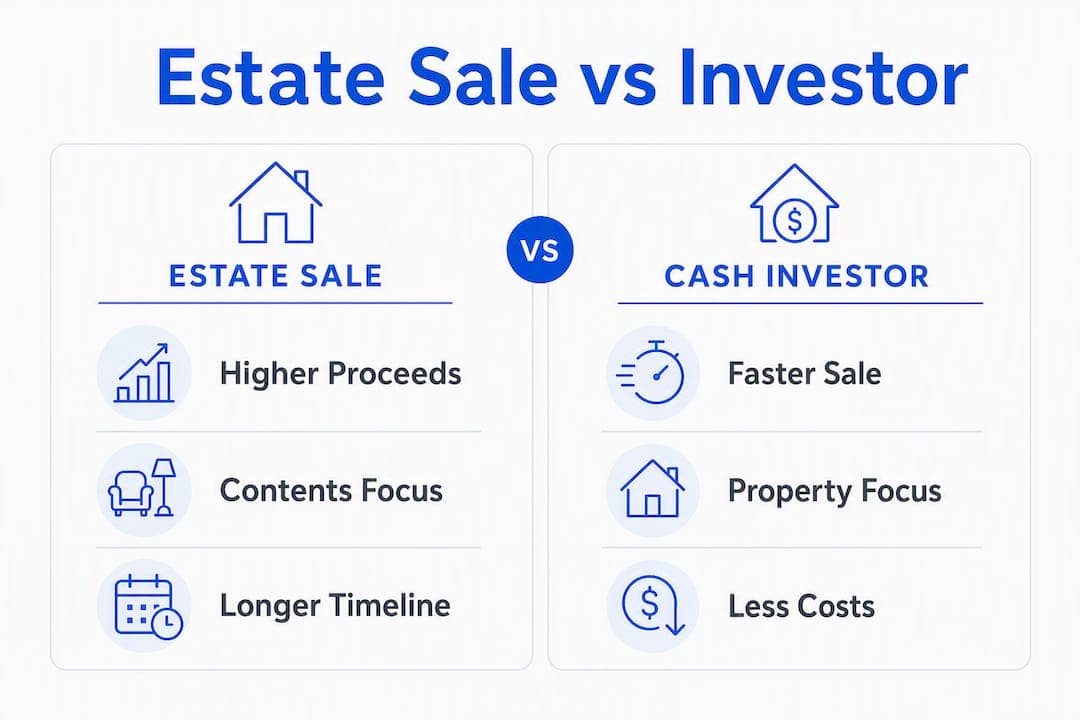
Cash investor or cash buyer buys the property itself, not the contents. They purchase the house as-is, meaning no repairs, no staging, no agent commissions. Some cash investors will also take remaining contents as part of the deal, which can simplify cleanup. The offer is typically below full market value because the investor is pricing in rehab costs and their own margin.
The scope difference matters enormously for executors. An estate sale handles the stuff. A cash investor handles the structure. A hybrid approach handles both, in sequence.
A few practical notes on estate sales worth knowing upfront: strangers walk through the home, sometimes in large numbers. Items can go missing. A reputable company carries insurance and has a security plan, but it’s a real consideration for families with sentimental items they want to protect.
How do estate sales and cash offers compare side by side?
| Dimension | Estate Sale | Cash Investor Offer |
|---|---|---|
| Net proceeds | Higher potential from contents; 35%–40% commission and $500–$3,000 in cleanout for 30%–50% unsold items reduce net | Below market value on house; no repairs, commissions, or cleanout costs |
| Timeline | 2–4 weeks prep + 2–3 day sale weekend | 7–30 days to close |
| Seller effort | High: sorting, staging, coordinating with company, being available | Low: submit details, review offers, sign, close |
| Fees & commissions | 35%–40% of gross sales; possible advertising and staffing fees | No agent commission; buyer typically covers closing costs |
| What is sold | Contents only (house stays with estate) | The property (house + land); contents by arrangement |
| Best-fit scenario | Curated valuables, patient heirs, organized estate | Inherited as-is, distressed property, out-of-state executor, probate deadline |
| Risk & predictability | Variable: depends on buyer turnout, item condition, market timing | High predictability: firm offer, no financing contingencies |
| Executor/legal duties | Must coordinate with estate sale company; unsold items require disposal plan | Simpler closing process; title and escrow handled by closing attorney |

A few things the table doesn’t capture: cash buyers eliminate financing contingencies, which means no deal falling through at the last minute because a buyer’s mortgage was denied. For executors managing a probate deadline, that certainty has real dollar value. On the estate sale side, the best outcomes happen when the contents include categories that actually move: fine jewelry, sterling silver, coins, antique furniture, and quality tools consistently drive most in-home sale revenue.
What do estate sales and cash offers actually cost?
Commission is only part of the story. Estate liquidation professionals regularly see families miscalculate total cost because they focus on the 35%–40% rate and ignore what happens after the sale ends.
Estate sale: the full cost picture
A typical estate sale commission runs 35%–40% of gross sales. On top of that, expect:
- Advertising and setup costs — some companies charge separately; others fold it into commission. Confirm in writing.
- Post-sale cleanout — about 30%–50% of items typically go unsold. Arranging donation pickup or junk removal costs $500–$3,000 depending on home size.
- Carrying costs — property taxes, utilities, and insurance continue while you prep and run the sale.
Sample scenario A — Mid-value household with antiques: Gross estate sale proceeds: $18,000. Commission is a sizable portion of sales; cleanout for unsold items can amount to over a thousand dollars. Net to estate: roughly $9,960. That’s about 55 cents on the dollar before carrying costs.
Sample scenario B — Distressed inherited property needing repairs: Home market value: $180,000. Needed repairs estimated at $35,000. Cash investor offer (as-is): $130,000. No agent commission, no repair costs, no staging. Net to estate: $130,000 at closing, typically within 14 days. A traditional listing after repairs might net $155,000 after a 5%–6% agent commission and three months of carrying costs — but only if the executor has the capital and time to manage the renovation.
Regional note: Commission rates, cleanout costs, and investor discount levels vary by market and property condition. These scenarios are illustrative; get multiple quotes before committing to either path.
How do you decide which option fits your estate?
Start with the asset, not the emotion. The right path depends on what you’re actually selling and what constraints you’re working under.
The core rule: If the estate has concentrated high-value items (jewelry, coins, antiques, quality tools) and heirs have four to six weeks of flexibility, prioritize an estate sale or auction for those items. If the property is distressed, the executor is out of state, probate has a deadline, or the contents are mostly low-value clutter, a competitive cash-offer marketplace like Housegoodbye is the faster and often smarter path.
Diagnostic questions to ask yourself
- What is the probate or estate settlement deadline? If it’s under 60 days, a cash offer is almost certainly the right call for the house.
- What condition is the property in? Deferred maintenance, water damage, or code violations make a traditional listing expensive and slow.
- What’s actually in the house? A mix of fine jewelry and particleboard furniture is a hybrid situation, not a pure estate sale.
- Where do the heirs live? Out-of-state executors managing a sale remotely face real coordination costs that erode estate sale net proceeds.
- Are there security concerns? High-value items and an open-house format carry theft risk.
- What are the tax and executor obligations? Some estates have specific timelines tied to tax filings or creditor claims.
Quick scoring heuristic
Give yourself one point for each “yes”:
- The estate contains fine jewelry, coins, antiques, or quality tools worth $10,000 or more
- Heirs can wait 4–6 weeks without financial pressure
- The property is in good condition and doesn’t need major repairs
- At least one heir or executor is local and available to coordinate
Score 3–4: Lean toward an estate sale for contents, traditional or cash-offer for the house depending on condition. Score 1–2: A cash-offer marketplace for the house is likely the better fit. Consider selling high-value items separately first. Score 0: Move directly to a cash offer. Speed and simplicity are your priorities.
Pro Tip: Before signing with any estate sale company, remove items you plan to keep or sell privately to avoid common home seller mistakes Ontario. Once the contract is signed, everything in the home is typically subject to the sale.
Next steps by path
If you’re leaning toward an estate sale, contact two to three companies within the next week, ask for a walkthrough and written commission quote, and confirm their policy on unsold items. If you’re leaning toward a cash offer, gather the deed, a rough sense of property condition, and any probate documentation. Platforms like Housegoodbye can generate competing offers quickly once you submit basic property details.
What should you ask before signing with any estate company or investor?
The contract you sign determines your exposure. Most problems families encounter, from missing items to surprise cleanout bills, trace back to vague terms agreed to under pressure.
Questions for estate sale companies
- What is the exact commission rate, and does it change if gross sales fall below a threshold?
- Who handles advertising, and is that cost included or billed separately?
- What is your markdown policy on day two and day three of the sale?
- How do you handle security during the sale? Do you carry liability insurance?
- What happens to unsold items? Who is responsible for removal, and at what cost?
Questions for estate buyers (content buyout)
- How do you arrive at your offer? Can you walk me through the valuation method?
- Is the offer for everything, or are certain items excluded?
- What is the pickup timeline after we agree?
- Do you guarantee full removal, or do some items stay?
Questions for cash investors
- Can you provide proof of funds before I accept?
- What is the exact closing timeline, and what happens if it slips?
- Who pays closing costs?
- Are there any inspection or repair contingencies in the offer?
- Who handles the title search and escrow?
Red flags to walk away from
- Any upfront non-refundable fee before the sale or closing
- Vague language around unsold item removal (“we’ll handle it” without a written plan)
- No proof of funds from a cash investor
- Pressure to sign immediately without time to review written terms
- Commission rates that change based on conditions buried in the contract
Avoiding common mistakes when selling inherited properties often comes down to slowing down enough to read what you’re signing.
Which estate scenario points to which option?
Fine jewelry, coins, and antiques with patient heirs
An estate with concentrated high-value collectibles is the strongest case for a professional estate sale or auction. Fine jewelry, sterling silver, coins, and antique furniture attract early cash buyers who pay well. For truly rare pieces, an auction house may outperform an in-home sale, with seller premiums of 15%–25% offset by competitive online bidding pushing final prices higher.
Recommendation: Estate sale for contents, then evaluate the house separately.
Out-of-state executor, short probate deadline, rental-condition property
Coordinating an estate sale from another state is expensive and stressful. Add a probate deadline and a property that looks like a long-term rental, and the math shifts hard toward a cash offer. The speed of a cash sale eliminates months of carrying costs and removes the coordination burden entirely.
Recommendation: Cash investor offer, close in 7–14 days.
House in disrepair with unpaid taxes or foreclosure risk
A distressed property with tax liens or active foreclosure proceedings has a shrinking window. Every week of delay costs money and options. A cash investor buys as-is, can often navigate title complications faster than a traditional buyer, and can close before the situation deteriorates further.
Recommendation: Cash offer immediately. See cash sale vs. foreclosure outcomes for what to expect.
Mixed household: some valuables, mostly clutter
This is the most common estate situation, and the answer is a hybrid approach. Pull the high-value items first — jewelry, coins, tools — and sell them privately or via auction. Then either run a smaller estate sale for the remainder or accept a cash offer for the house with contents included. Paying 38% commission on a room full of particleboard furniture and outdated electronics is money left on the table.
Recommendation: Sell valuables first, then cash offer for the house.
How does a competitive cash-offer marketplace change the outcome?
A single cash investor has every incentive to offer as little as you’ll accept, but a marketplace where multiple vetted investors compete for the same property changes that dynamic.
When an inherited property in Michigan goes through a platform like Housegoodbye, multiple local investors submit competing bids. The seller sees the range, not just one number. That competition tends to push the final accepted offer higher than a single-buyer negotiation would produce, while preserving the same speed and as-is convenience.
| Scenario | Single Investor Offer | Competitive Marketplace Offer | Estimated Net After Closing Costs |
|---|---|---|---|
| — | — | $155,000 | — |
Sample figures for illustration; actual offers depend on property condition, location, and current investor activity.
Beyond the offer price, a faster close reduces vacancy costs. An estate property sitting empty for 60–90 days while a traditional listing plays out accumulates property taxes, utilities, insurance, and potential maintenance issues. Closing in 7–14 days through multiple competing cash offers eliminates that exposure entirely.
Key Takeaways
An estate sale maximizes proceeds from high-value contents but takes 2–4 weeks and leaves about 30%–50% of items unsold, with cleanout costs of $500–$3,000 common; a competitive cash-offer marketplace like Housegoodbye closes the property in as little as 7 days with no repairs, commissions, or cleanout required.
| Point | Details |
|---|---|
| Estate sale commission | Expect 35%–40% of gross sales, plus $500–$3,000 in post-sale cleanout costs for the 30%–50% of items that may remain unsold. |
| Cash offer timeline | A cash investor can close in about one week; estate sales typically run 2–4 weeks from contract to sale day. |
| Hybrid path | Sell high-value items (jewelry, coins, antiques) via auction or private sale first, then take a cash offer for the house. |
| Top red flag | Any upfront non-refundable fee or vague unsold-item removal terms in an estate sale contract. |
| Housegoodbye advantage | Submitting to a multi-investor marketplace generates competing bids, pushing offers higher than a single-buyer negotiation typically produces. |
The trade-off most heirs don’t see until it’s too late
The estate sale vs. cash investor comparison gets framed almost universally as “more money vs. faster money.” That framing is too simple, and it leads families to make the wrong call.
The real question is: what are you actually selling, and what does the total cost of each path look like when you add up every line item? Estate sale commission is visible. The cleanout bill for unsold furniture often adds significant cost. The three months of property taxes and utilities while you prep, run, and recover from a sale aren’t. The emotional cost of strangers walking through a parent’s home for a weekend isn’t in any spreadsheet.
Cash offers get dismissed too quickly because the headline number looks low. But when you net out repairs, agent commissions, carrying costs, and the time value of a faster resolution, the gap between a well-run competitive cash offer and a traditional listing often shrinks to a few thousand dollars. For an executor managing probate, creditor claims, and out-of-state logistics, that difference is frequently worth paying.
The families who come out best are the ones who sequence correctly: identify what’s genuinely valuable, sell it through the right channel, and then move the property through the fastest path that meets their net-proceeds floor. Housegoodbye’s marketplace approach fits that second step well, particularly for Michigan estates where speed and certainty matter more than squeezing the last dollar from a listing.
Get competing cash offers for your Michigan estate property
Selling an inherited or estate property in Michigan doesn’t have to mean months of prep, repairs, and uncertainty. Housegoodbye connects Michigan homeowners with multiple vetted local investors who compete for the property, generating offers you can actually compare rather than a single take-it-or-leave-it number.

The process is straightforward: submit basic property details, receive competing cash offers from local investors, compare them side by side, and choose the one that fits your timeline and net-proceeds target. No repairs, no staging, no agent commissions. Closing can happen in as little as 7 days, which matters when probate deadlines or carrying costs are in play.
To get started, have the deed, a rough sense of property condition, and any probate documentation ready. Visit Housegoodbye’s cash home buyers page to submit your property and see what competing investors will pay. If you want to understand the as-is process before committing, sell your house as-is in Michigan walks through exactly what to expect.
Useful sources
- What Sells at Estate Sales? — Busby Estate Liquidation & Realty Services
- Cash Buyers Benefits for Estate Properties — Housegoodbye
FAQ
What items don’t sell well at estate sales?
Mass-produced particleboard furniture, outdated electronics, used mattresses, and generic glassware consistently underperform or go unsold. Donating or discarding these before the sale preserves staging space for higher-value items.
What is the least expensive way to sell a house?
Selling to a cash investor through a competitive marketplace typically costs the least in total fees, since there are no agent commissions, no repair costs, and no staging expenses. The trade-off is accepting an offer below full market value.
Why do realtors and agents prefer cash offers?
Cash offers eliminate financing contingencies, which means no risk of a deal collapsing because a buyer’s mortgage falls through. For agents, that translates to faster, more reliable closings with fewer complications.
What is the hardest month to sell a house?
January and February are historically the slowest months for home sales in most U.S. markets, with lower buyer activity and fewer competing offers. For estate sellers on a deadline, a cash investor offer removes seasonal timing risk entirely.