Yes, you can usually sell a probate home in Michigan while the estate is still open, but only once a probate court has appointed a personal representative with Letters of Authority. If those letters restrict the sale power or an heir objects, you will also need court confirmation under MCR 5.207 and Petition PC 681. Skip that step and the sale can be challenged after the fact.
TL;DR:
- A personal representative can sell a probate home in Michigan during estate proceedings only after obtaining Letters of Authority, with court confirmation required if sale restrictions or objections apply.
- Conducting an appraisal early, ideally within the same week as receiving Letters of Authority, is crucial to avoid delays caused by busy county appraisers.
- The sale process involves filing specific court forms such as PC 681 and PC 682, notifying interested parties, and possibly attending a confirmation hearing if required.
- Costs include court fees, appraisals, publication notices, and potential bonding expenses, with liens presenting the biggest risk to net proceeds.
- Cash buyers often close in 7 to 30 days and are suitable for estates needing quick cash, while traditional listings can take 30 to 90 days or longer, depending on circumstances.
Table of Contents
- Can You Sell a House Before, During, or After Probate in Michigan?
- Step-by-Step: How to Sell a Home During Probate in Michigan
- Court Filings and Forms Every Michigan Executor Should Know
- What Does a Probate Sale Cost, and How Long Does It Take?
- Cash Buyer, Agent, or FSBO: Which Fits Your Estate?
- Appraisals, Repairs, and What Courts Expect From a Sale Price
- Closing the Sale and Wrapping Up the Estate
- What I’d Tell an Executor Handling Their First Michigan Probate Sale
- How Housegoodbye Helps You Sell a Michigan Probate Home Fast
- Official Forms and County Pages Worth Bookmarking
- Sources
- FAQ
Can You Sell a House Before, During, or After Probate in Michigan?
Timing determines who has legal authority to sign, and that authority determines whether the sale will hold up.
Before probate opens, selling is usually not possible. No one holds title or the legal right to transfer it until a court appoints someone to act for the estate.
During probate, a personal representative with Letters of Authority can typically list and sell the property. Whether the court has to confirm that sale under MCR 5.207 depends on two things: whether the letters restrict the sale power, and whether any heir or interested party objects. Michigan’s Estates and Protected Individuals Code gives probate courts jurisdiction over these disputes and spells out what powers a representative carries by default.
After probate closes, the heirs who inherited the property hold clear title and can sell on their own terms. That freedom comes with a catch: they now personally handle capital gains exposure, disclosure obligations, and any liens that surface after the fact.
Step-by-Step: How to Sell a Home During Probate in Michigan
The order matters here. Skip a step and the county probate clerk will bounce your filing back, adding weeks to a process that already moves slowly.
- Confirm your appointment and read your Letters of Authority carefully. They will state outright whether you can sell without asking the court first, per the Wayne County Probate Court’s standard guidance on representative powers.
- Get an appraisal or a current assessor’s statement. You will need the State Equalized Value on file no matter which route you take.
- File Petition PC 681 and the proposed Order PC 682 if court confirmation is required. The petition needs the property’s legal description, the sale terms, and that assessor’s statement, per Michigan’s own PC 681 form instructions.
- Send required notices to interested persons and publish notice to creditors under the applicable court rules.
- Attend the confirmation hearing. Bring the appraisal, the signed purchase agreement, and proof of creditor notice. Be ready to respond if an heir objects to price or terms.
- Close the sale. Confirm liens are cleared, transfer taxes are paid, and start preparing the final accounting the court will expect before the estate closes.
Pro Tip: Order the appraisal the same week you receive your Letters of Authority. Appraisers in busy Michigan counties can be booked out ten days or more, and that delay quietly eats into your entire timeline before you have even filed anything.
Court Filings and Forms Every Michigan Executor Should Know
Three names come up constantly in Michigan probate sales, and knowing what each one does saves you a trip back to the courthouse.
- PC 681 (Petition for Approval of Sale of Real Estate): Requires the legal description, proposed sale terms, and a recent assessor’s statement showing State Equalized Value.
- PC 682: The proposed order the judge signs to formally confirm the sale once the petition is approved.
- MCR 5.207: Sets the procedural backbone for confirmation, covering petition contents, who must receive notice, appraisal standards, and when the court can require a bond, as Kent County’s probate guidance lays out.
- EPIC (Act 386 of 1998): The statute establishing probate court jurisdiction and a representative’s baseline authority over estate property.
Conservatorship cases follow a similar pattern. Selling a protected individual’s home under an active conservatorship typically requires court approval too, under MCL 700.5423, with forms PC 646 and PC 647 filling roughly the same role that PC 681 and PC 682 play in decedent estates. All of these forms live on the state’s approved forms index at courts.michigan.gov, not on any third-party site.
What Does a Probate Sale Cost, and How Long Does It Take?
Timelines vary by county and by whether a sale requires confirmation, but executors should plan for the sale itself to take longer than a typical retail closing, even when the underlying real estate market moves fast.
Court filing fees, appraisal costs, and publication or notice expenses add up before you even get to closing costs. Some estates face a required probate bond, and premiums scale with the estate’s value. Practical Michigan probate guides note that these combined costs and the confirmation hearing schedule are the two biggest sources of delay in an otherwise straightforward sale.
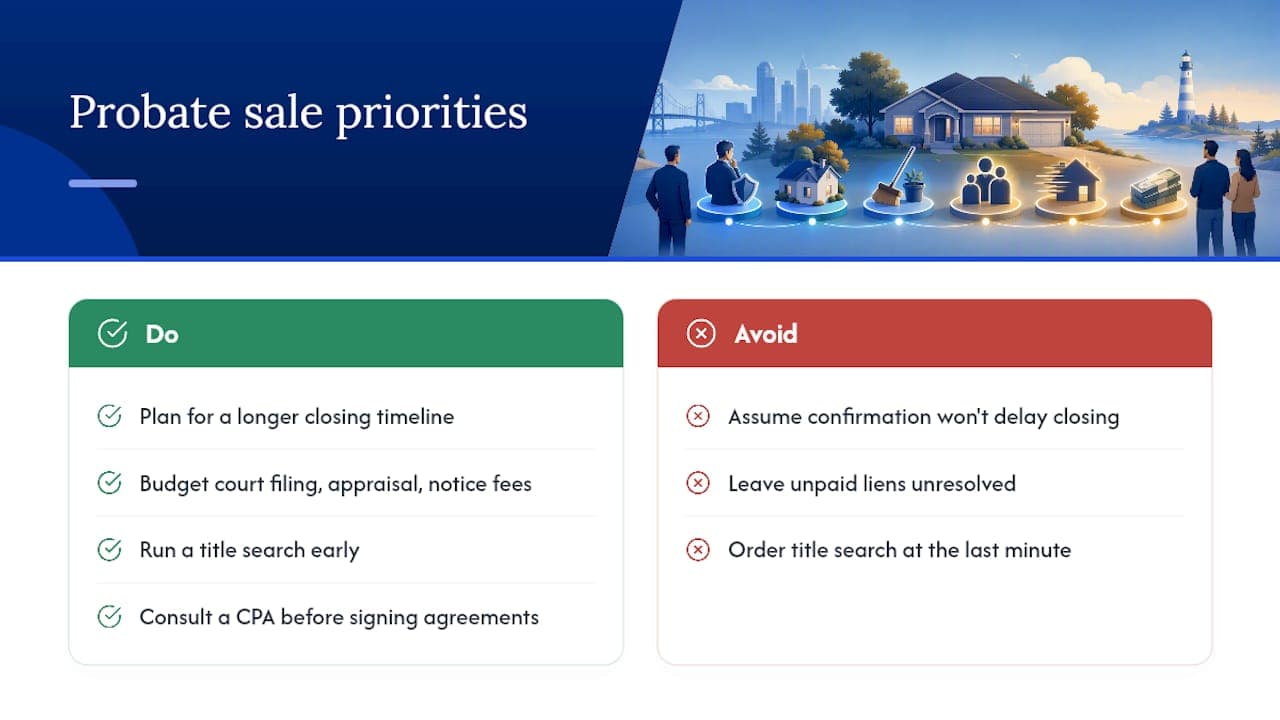
The real risk to net proceeds isn’t the court process. It’s liens. Unpaid property taxes, contractor liens, or a second mortgage nobody remembered can quietly erase equity you were counting on. Run a title search early, not the week before closing, and resolve anything that surfaces. For anything involving capital gains treatment on inherited property or estate tax exposure, loop in a CPA before you sign a purchase agreement, not after.
Cash Buyer, Agent, or FSBO: Which Fits Your Estate?
The right selling method depends less on getting the highest price and more on what your estate actually needs right now.
- Cash investor: Often closes in 7 to 30 days, buys as-is, and skips repairs entirely. This route fits estates facing creditor pressure, ongoing holding costs, or heirs who live out of state and cannot manage a renovation. Cash buyers who specialize in probate also tend to already understand the paperwork, which cuts down on the back-and-forth that slows other sales.
- MLS with an agent: Usually brings a higher sale price but takes 30 to 90 days or longer, and the estate pays a commission plus carries the property through showings and negotiations.
- FSBO: Saves on commission but puts the full workload, marketing, showings, and negotiation, on the personal representative, who is often already stretched thin managing court deadlines.
Pro Tip: If your siblings or co-heirs disagree on price, a cash offer with a fixed number often ends the argument faster than a listing that invites months of back-and-forth over counteroffers.
Run through a short checklist before deciding: Does the estate need cash now to pay debts? Can it absorb months of taxes, insurance, and utilities while a listing sits? Does the property need repairs nobody wants to pay for upfront? Is the family aligned, or will a drawn-out sale invite more disputes? Your answers point you toward the faster route or the higher-ceiling one.
Appraisals, Repairs, and What Courts Expect From a Sale Price
Michigan probate courts want documented evidence that a sale price reflects fair market value, not a guess. That is why the assessor’s statement and appraisal matter so much on PC 681.
- Get the appraisal done early so it is not stale by the time you file.
- Weigh repair costs against how much they would actually add to the sale price. Cosmetic fixes rarely move the needle enough to justify the delay.
- Selling as-is often makes more sense for estates on a court timeline than gambling on a renovation’s return.
- Title companies and buyers will expect clean documentation of the court’s authority. Have your Letters of Authority and any confirmation order ready before you get to the closing table.
Closing the Sale and Wrapping Up the Estate
Closing day is not the finish line. What happens with the money afterward is what the probate court actually reviews.
- Proceeds typically pay liens and property taxes first, then administration expenses, then valid creditor claims, and only then distributions to heirs.
- Document every distribution and file a final accounting with the probate court showing exactly where the money went.
- Watch for late creditor claims and insufficient proceeds. An escrow hold or a small reserve can prevent a distribution from being reversed later.
- Keep the appraisal, closing statement, all notices sent, and every court order. You may need them if a claim or dispute surfaces months later.
What I’d Tell an Executor Handling Their First Michigan Probate Sale
Get your Letters of Authority in hand and your appraisal ordered before you do anything else. Those two documents drive every deadline that follows, and starting late is the single most common reason a probate sale drags on for months instead of weeks.
Hire probate counsel who works in your specific county, and pick a title company that has closed probate sales there before. County practices differ enough on notice and hearing scheduling that generic advice can steer you wrong. And if your estate is bleeding cash on taxes, insurance, and utilities every month it stays open, a fast cash offer is not a compromise. It is often the smartest math on the table.
— Bryan
How Housegoodbye Helps You Sell a Michigan Probate Home Fast
If your estate is short on time or your Letters of Authority don’t leave room for a 60 day listing, you can get multiple cash offers from local investors instead of a single lowball number from one buyer. That competition can help push the price compared to accepting the first offer that lands in your inbox.

The sale is as-is, with no repair list, staging, showings, or agent commission reducing what the estate distributes. Closing can sometimes happen quickly once the personal representative has authority to sign, which matters when creditor pressure or monthly holding costs drain the estate faster than a traditional sale can close. This option may fit estates with deferred maintenance, out-of-state heirs who cannot manage a renovation, or a court timeline that cannot wait on a slow buyer pool.
If that sounds like where you are, compare real cash offers for your Michigan property and see what investors are willing to pay before you commit to a listing timeline the estate can’t afford.
Official Forms and County Pages Worth Bookmarking
- PC 681 petition form, for the sale petition and required assessor’s statement.
- Kent County’s sale of property page, covering MCR 5.207 confirmation procedure.
- Wayne County Probate Court’s real estate sale guidance, on when confirmation is and isn’t required.
- The full EPIC statute text, for representative authority and court jurisdiction.
- The state’s SCAO forms index, for PC 682 and every other approved probate form.
This article is general information, not a substitute for advice from a qualified lawyer. Consult a qualified legal professional about your own circumstances before acting on anything here.
Sources
- PC 681, Petition for Approval of Sale of Real Estate (Decedent Estate)
- Sale of Property | Kent County, MI
- Estates and Protected Individuals Code (EPIC) — Act 386 of 1998
- Sale of Real Estate (Wayne County Probate Court)
FAQ
What Happens if You Sell Property Before Probate?
A sale before probate opens generally has no legal force because no one yet holds authority to transfer title. Any buyer’s title would be clouded, and the transaction could be voided once an estate is opened.
How Much Does an Estate Have to Be Worth to Go Through Full Probate in Michigan?
This depends on the estate’s total value and asset types, and thresholds change periodically, so check current figures with your county probate court before assuming your estate qualifies for a simplified process.
What Are the Steps to Sell a House in Probate in Michigan?
Get appointed and confirm your Letters of Authority, order an appraisal, file PC 681 and PC 682 if court confirmation is required, send notices, attend the hearing if one is scheduled, then close and file a final accounting.
What Property Is Exempt From Probate in Michigan?
Assets held in joint tenancy with right of survivorship, property in a living trust, and accounts with named beneficiaries, like life insurance or retirement accounts, typically pass outside probate and are not subject to the sale process described here.