An appraisal gap is the difference between the price a buyer and seller agreed on and the lower value an appraiser puts on the home. If the contract says $300,000 and the appraisal comes back at $285,000, the gap is $15,000. The lender bases the loan on the lower number, so someone has to deal with that shortfall before the sale can close.
This guide explains how the gap is calculated, why it happens, what it means for each side of the deal, and how it differs from a tax assessment. It also covers what sellers can do when a financed buyer’s appraisal falls short.
TL;DR
- An appraisal gap is the contract price minus the appraised value, when the appraisal is the lower of the two.
- Lenders lend against the appraised value, so the buyer usually needs more cash, a lower price, or a new deal.
- Appraisal gap coverage is a clause where the buyer promises in advance to pay some or all of the difference.
- An appraisal is a one-time value opinion for a transaction. A tax assessment is a recurring government figure used for property taxes.
- Sellers who cannot risk a financing-dependent appraisal can look at as-is cash offers, where the buyer’s lender is not setting the value.
Table of Contents
- What an appraisal gap means
- How to calculate an appraisal gap
- Why appraisals come in low
- Why the gap matters to buyers, sellers, and lenders
- Appraisal gap coverage, explained
- What happens when the appraisal comes in low
- Appraisal vs. tax assessment
- Tips for buyers and sellers facing a gap
- Our perspective
- Selling in Michigan without an appraisal risk
- FAQ
- Sources
What an appraisal gap means
An appraisal is a professional opinion of what a home is worth, as the Consumer Financial Protection Bureau describes it. A mortgage lender orders one to make sure the property supports the loan. A buyer and seller, meanwhile, set the price through negotiation, and in a busy market that price can run ahead of what recent sales support.
The gap shows up when those two numbers disagree. Contract price higher than appraised value means a gap. Appraisal at or above the price means no gap at all.
You will also see it phrased as an appraisal shortfall, a low appraisal, or a valuation gap. They mean the same thing in a typical purchase.
How to calculate an appraisal gap
The formula is simple: purchase price minus appraised value. The harder part is what the gap does to the buyer’s financing.
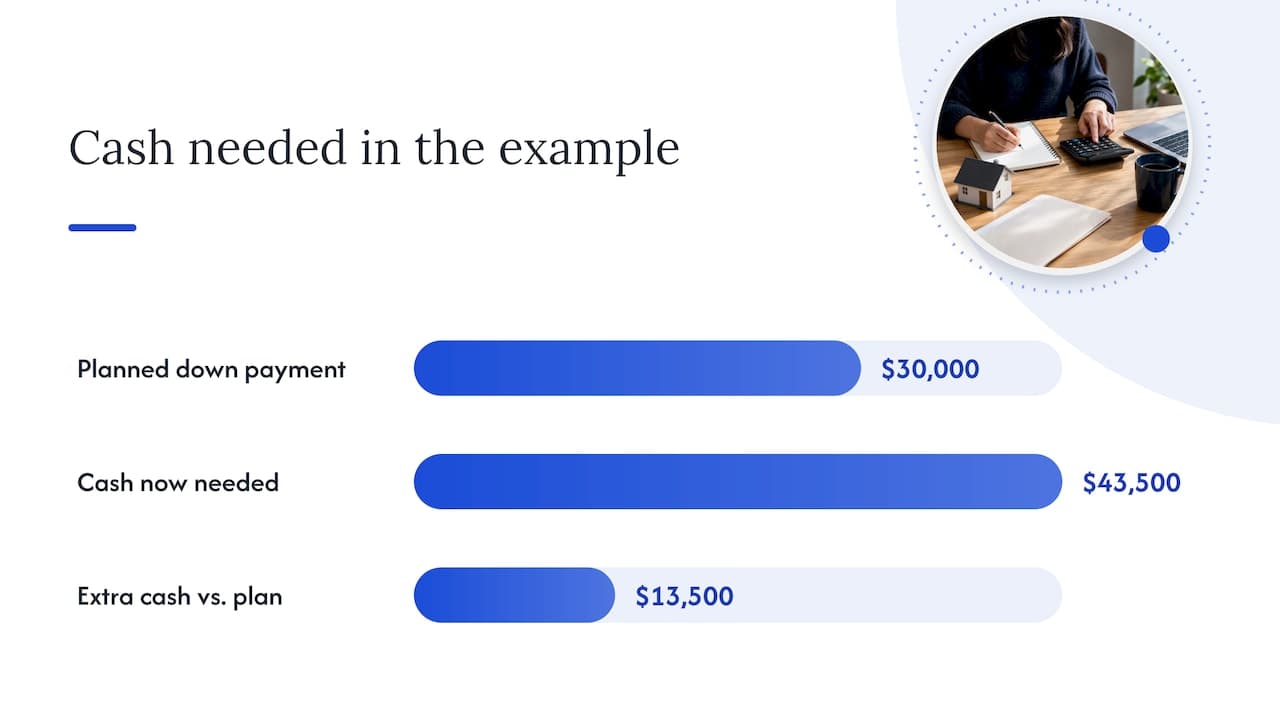
Here is a hypothetical example. A buyer agrees to pay $300,000 and plans to put 10% down with a 90% loan.
| Item | Amount |
|---|---|
| Agreed purchase price | $300,000 |
| Appraised value | $285,000 |
| Appraisal gap | $15,000 |
| Planned down payment (10% of price) | $30,000 |
| Maximum loan at 90% of appraised value | $256,500 |
| Cash the buyer now needs | $43,500 |
| Extra cash compared with the plan | $13,500 |
Notice the buyer does not simply owe the $15,000 difference. Because the loan is sized to the appraised value, the buyer’s extra cash need depends on the loan-to-value ratio. At 90% financing, the lender covers 90% of the appraised value, so the buyer makes up $13,500 more than planned. Your lender can run the exact math for your loan type.
Buyers who want to know their budget before they bid can use a mortgage affordability calculator to see how much cushion they have for a surprise like this.
Why appraisals come in low
A low appraisal does not always mean the buyer overpaid. Common causes:
- Fast-rising prices. Appraisers lean on closed sales, which lag behind current offers.
- Bidding wars. Competing offers can push a price above what comparable sales support.
- Condition. Deferred repairs, outdated systems, or damage lower a value estimate. Our guide to costly repairs that kill home deals shows which issues weigh most.
- Few comparables. Unusual homes or thin neighborhoods make the estimate harder.
- Bias. The New Jersey Attorney General’s guidance notes that racial and ethnic bias in appraisals contributes to undervaluation of homes in majority Black neighborhoods. Owners who suspect this have a right to push back.
Why the gap matters to buyers, sellers, and lenders
For the buyer, the shortfall can mean a larger down payment. The same New Jersey guidance notes that a below-contract appraisal may require a buyer to increase their down payment, which may cause the sale to fall through. Buyers who stretched their budget to win the house often have no room for that.
For the seller, the gap is a risk to the whole sale. If the buyer cannot cover it, the seller either lowers the price, finds another buyer, or both. That can mean weeks of lost time, carrying costs, and a home that now has a failed contract in its history. Sellers dealing with a mortgage payment, a probate timeline, or a move often cannot absorb that delay.
For the lender, the appraisal protects the loan. Appraisals help lenders make informed lending decisions and help buyers avoid overpaying. The lender will not fund more than its formula allows against the appraised value, no matter what the contract says.
Appraisal gap coverage, explained
In competitive markets, buyers sometimes add an appraisal gap clause to their offer. It commits the buyer to cover all or a set portion of the difference if the appraisal falls short. NerdWallet’s explanation covers how buyers use it to compete.
A typical clause looks like this: the buyer offers $300,000 and agrees to pay up to $10,000 above the appraised value out of pocket. If the home appraises at $292,000, the buyer covers the $8,000 gap. If it appraises at $285,000, the gap is $15,000, and the clause only covers $10,000 of it, leaving $5,000 to negotiate.
What sellers should look for in a gap offer:
- A dollar cap or percentage. Open-ended language is rare and hard to enforce.
- Proof of funds. Gap coverage is only as good as the cash behind it. Ask for bank statements showing money set aside beyond the down payment and closing costs.
- The remaining contingencies. A strong gap clause paired with a financing contingency can still leave the seller exposed.
- The loan type. Some loan programs have rules that limit how a buyer can use seller concessions or outside funds, so check with the lender.
For buyers, coverage is a bet. Money set aside for a gap is money you cannot use for repairs, moving, or a cushion after closing.
What happens when the appraisal comes in low
There are four common paths, and most deals end up on one of them.
Renegotiate the price
This is the most common outcome. A study of appraisal outcomes published through the CFPB found that 57% of sales completed despite a negative appraisal were renegotiated downward, with median buyer savings of 2.5%, or about $6,000. A low appraisal often works as a negotiating tool for the buyer.
Split the difference
The seller drops the price part of the way, and the buyer brings extra cash for the rest. Both sides accept a smaller loss than losing the deal entirely.
Challenge the appraisal
If the appraiser missed comparable sales, misread square footage, or overlooked upgrades, the buyer’s lender can submit a Reconsideration of Value request. Fannie Mae’s rules generally limit borrowers to one borrower-initiated request per appraisal, so the request should include strong, recent comparables and not just an argument that the number feels low. Sellers can help by supplying a list of upgrades and recent comparable sales to the buyer’s agent.
Walk away
Most purchase contracts include an appraisal contingency. It allows the buyer to cancel and recover earnest money if the appraisal falls short of the price. A buyer who waived that contingency risks losing the deposit, so read the contract carefully.
Sellers whose homes need work often face the same pressure from the other direction. Our piece on how inspection negotiations cost sellers shows how repair requests and low valuations tend to stack up in the same deal.
Appraisal vs. tax assessment
People search for this difference because both produce a dollar value for the same house, and the two numbers rarely match.
| Appraisal | Tax assessment | |
|---|---|---|
| Purpose | A purchase, refinance, or other transaction | Calculating property taxes |
| Who does it | A licensed appraiser, usually ordered by the lender | The local government |
| How often | One time, for a specific deal | Recurring, across the whole jurisdiction |
| What it reflects | What a buyer would pay today | Older, standardized data for consistency |
Chase notes that an appraisal is a one-time evaluation for a transaction, while an assessment is a recurring mass-appraisal process, and that tax bills come from applying a local rate to the assessed value, not the market value. So a low assessment does not tell you the appraisal will be low, and a high appraisal does not raise your taxes on its own.
The appraisal gap only involves the appraisal. If your house has an assessed value of $200,000 and a contract price of $300,000, that is not a gap. The lender never uses the assessment to size the loan.
Tips for buyers and sellers facing a gap
If you are buying:
- Ask your agent for the comparable sales behind your offer before you bid above asking.
- Decide in advance how much extra cash you can truly spare.
- Keep the appraisal contingency unless you are certain you can cover a shortfall.
- Ask your lender how the loan amount changes if the value comes in low.
If you are selling:
- Price from recent closed sales. A comparative market analysis helps, and we explain what it can and cannot do.
- Prepare a list of upgrades and permits for the appraiser.
- Look past the headline price. A higher offer with a financing contingency can be riskier than a slightly lower one with strong cash backing.
- Decide in advance the lowest price you would accept, so you can answer a renegotiation fast.
Our perspective
We see the appraisal gap from the seller’s side of the table. A financed buyer’s offer looks strong until a third party, the appraiser, puts a different number on the house. By then the seller has often taken the home off the market, turned down other interest, and made plans around a closing date.
That is why we built HouseGoodbye the way we did. In our marketplace, several vetted local cash buyers bid on the same house, and the seller sees every offer. Our approach is designed so that you compare real numbers up front instead of waiting for a lender’s valuation to decide the outcome. If none of the offers work, you walk away with no obligation.
We also think the gap is most painful for homes that are not in perfect shape: inherited houses, vacant properties, homes with water damage or code violations. Those are exactly the homes where an appraisal is hardest to predict. Cash buyers who purchase as-is price the house for what it is, and you do not make repairs or hold showings to get there.
Not every sale needs this route. But if a low appraisal would put you in a bind, it is worth seeing what competing cash offers look like before you accept a contract that depends on one.
Bryan
Selling in Michigan without an appraisal risk
If you own a house in Michigan and the idea of waiting on a buyer’s appraisal worries you, there is another route. At HouseGoodbye, you enter your address and vetted local cash buyers compete with as-is offers. There are no listing fees, no agent commissions, and no required repairs. We say typical closings take about 7 days, compared with about 73 days on the MLS.

Wondering how appraisals work in a cash sale? Read whether a cash offer needs an appraisal, or see how cash buyers set their numbers. When you are ready to compare offers, start at HouseGoodbye. Investors also use after-repair value in their math, which we explain in our ARV guide.
FAQ
What is an appraisal gap in simple terms?
It is the amount by which the appraised value falls below the agreed purchase price. If a buyer agrees to pay $400,000 and the home appraises at $380,000, the gap is $20,000. The lender bases the loan on the lower number.
Who pays the appraisal gap?
It depends on the contract. The buyer may cover it from savings, especially with a gap clause, or the seller may lower the price. Often the two split it. If no one agrees, the buyer can usually cancel under the appraisal contingency and recover earnest money.
Is an appraisal the same as a tax assessment?
No. An appraisal is a one-time opinion of market value for a specific transaction. A tax assessment is the government’s recurring figure used to calculate property taxes. The two numbers often differ, and only the appraisal affects loan sizing.
Can a low appraisal be challenged?
Yes, in many cases. The buyer’s lender can submit a Reconsideration of Value with better comparable sales or corrections to the home’s details. Fannie Mae’s rules generally limit borrowers to one such request per appraisal, so it should be well supported.
Does a cash sale have an appraisal gap?
A cash buyer is not borrowing, so no lender sets the loan against a value. Cash buyers still evaluate the property, but the price comes from their offer and your decision to accept it, not a lender’s appraisal.
Sources
- My appraisal is less than the sale price. What does that mean for me? (CFPB)
- Guidance on Discrimination in Home Appraisals (New Jersey Office of the Attorney General)
- Assessment vs. Appraisal (Chase)
- Appraisal Gap: What Buyers Can Do (NerdWallet)
- Information Losses in Home Purchase Appraisals (CFPB research)
- Appraisal Quality Matters (Fannie Mae Selling Guide)