If your Michigan home has foundation damage, you can still sell it fast: either take competing cash offers from investors who buy as-is, or invest in repairs and list traditionally if the numbers pencil out. Urgent sellers with unaffordable repair bills usually come out ahead going the cash-offer route. Either way, Michigan law requires you to disclose known defects to any buyer before they sign a purchase agreement.
TL;DR:
- Selling to multiple vetted investors through a marketplace often yields higher net proceeds than negotiating with a single buyer, especially for homes with foundation issues.
- Foundation repair costs in Michigan typically range from $8,000 to over $25,000, depending on pier count, depth, access, and whether the problem is settlement or heave.
- Michigan law requires full disclosure of known foundation defects before signing a purchase agreement, regardless of whether the house is sold “as-is” or repaired.
- If repairs are cost-effective and the estimate is lower than the added value at sale, fixing the foundation beforehand generally makes more financial sense; otherwise, selling as-is is often better.
- Expect a discount of 10% to 30% on homes with structural problems, with severe issues commanding the largest reductions but potential for better offers through competition.
Table of Contents
- Can I Sell a House With Foundation Issues in Michigan?
- How Much Does Foundation Repair Cost in Michigan?
- Do You Have to Disclose Foundation Problems When Selling in Michigan?
- How Do You Prepare a House With Foundation Issues to Sell As-Is?
- How Do Cash Offer Marketplaces Work for Damaged Homes?
- What Discount Should You Expect Selling a House As-Is?
- Which Path Actually Makes Sense for Your Situation
- Get Multiple Cash Offers on Your Michigan Home Through Housegoodbye
- Michigan Law and Foundation Repair Resources
- Sources
- FAQ
Can I Sell a House With Foundation Issues in Michigan?
Yes, and you have more paths than most homeowners realize. The right one depends on how much cash you have on hand, how fast you need to close, and how bad the damage actually is.
Repair and list. This route gets you the widest buyer pool, including buyers using FHA and VA loans. Those loan programs enforce minimum property standards, and unresolved structural issues commonly block financed buyers from qualifying at all. That means an unrepaired foundation often shrinks your buyer pool down to cash purchasers and investors from the start, whether you fix it or not. Repair-and-list also means carrying the home longer: contractor scheduling, permit inspections, and a full listing cycle can stretch the process to two or three months before you even get an offer.
Sell as-is to cash buyers. Individual investors, house-flippers, and landlords looking for rental stock will buy homes with known structural problems, usually at a discount that reflects their own repair risk. You skip inspections, financing contingencies, and most of the back-and-forth that kills financed deals.
Investor marketplace vs. single-buyer offers. Selling to the first investor who calls almost always leaves money on the table. A marketplace where multiple vetted investors bid on your property tends to push net proceeds higher, because buyers know they’re competing rather than negotiating against a seller with no leverage.
Fallback options. Auctions move a property fast but usually at a steeper discount than a negotiated cash sale. Donating a severely damaged property can make sense for a tax deduction in extreme cases. Owner financing works if you don’t need the full payout immediately and are comfortable carrying the note.
- Repair and list: widest buyer pool, longest timeline, upfront cash needed
- Sell as-is to cash buyers: fast, no repairs, discounted price
- Investor marketplace: multiple bids, typically higher net proceeds than a single offer
- Auction, donation, or owner financing: niche fits for specific financial situations
How Much Does Foundation Repair Cost in Michigan?
Underpinning work with push piers or helical piers commonly runs $8,000 to $25,000 or more, and severe cases with many piers or difficult access can push past that. Drainage correction alone, without structural lifting, tends to land on the lower end of that range.
Michigan’s geology makes this a bigger gamble than in many other states. Glacial clay soils expand and contract with moisture, and the state’s freeze-thaw cycles push frost several feet into the ground each winter. Those conditions drive both the type of damage a house develops and how much repairing it costs. A slab that’s settling in Farmington Hills clay behaves differently than one heaving in a sandier lot near Lake Michigan, and the fix isn’t interchangeable.
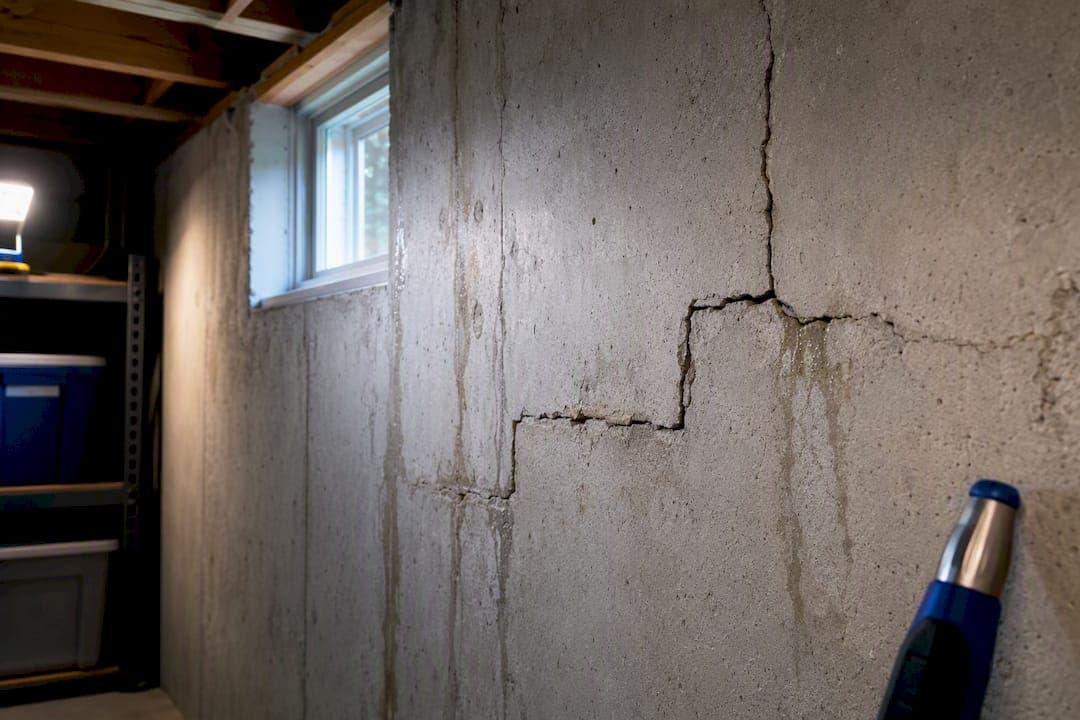
Statistic snapshot: Multi-pier underpinning jobs in Michigan typically fall between $8,000 and $25,000+, with cost scaling directly with pier count, depth to stable soil, and site access.
A few things swing that price range hard:
- Pier count and depth. More piers, or piers that need to reach deeper for stable soil, add labor and material cost fast.
- Access. A crawlspace or tight side-yard clearance slows equipment and raises labor hours.
- Settlement vs. heave. These are different problems with different fixes. Settlement usually calls for underpinning, while heave is often a moisture and drainage issue. Using the wrong method can make the damage worse, not better, which is why drainage correction gets recommended so often in Michigan regardless of which direction the foundation is moving.
- Simultaneous problems. A house that’s settling on one side and heaving on another needs two different repair strategies at once, which multiplies cost.
Before you decide anything, get a licensed structural engineer or a foundation contractor on-site. A phone estimate based on photos is a guess. A site visit with soil probes and crack measurements is the number you can actually plan around.
Do You Have to Disclose Foundation Problems When Selling in Michigan?
Yes. Michigan’s Seller Disclosure Act requires sellers of one to four unit residential properties to hand buyers a completed disclosure statement before they sign a purchase agreement, and that disclosure has to cover known physical defects to the best of your knowledge and information. Foundation problems fall squarely inside that requirement.
The form specifically asks about settling, flooding, drainage, grading, and structural conditions. If you skip the disclosure or hand it over after the buyer has already signed, the buyer can typically walk away from the deal and demand their deposit back.
Here’s what trips up a lot of sellers: “as-is” doesn’t mean “no disclosure.” An as-is clause protects you from having to make repairs. It does not protect you from a lawsuit if you knew about a cracked foundation wall and checked “no” on the disclosure form anyway. Michigan courts treat deliberate concealment as a different problem than an honest, documented “yes, we know about this” answer.
You’re not required to inspect areas you can’t reasonably access, like a sealed crawlspace or behind finished basement walls. But you are required to disclose what you actually know.
- Deliver the disclosure statement before the purchase agreement is signed, not after
- Answer settling, drainage, and structural questions honestly, based on what you actually know
- Amend the disclosure if a condition changes or you learn something new before closing
- Keep every repair receipt, permit, and contractor report on file
Pro Tip: If you’ve had any foundation work done, even minor crack injections, attach the contractor’s report to your disclosure packet. It shows the buyer exactly what was done and protects you if a dispute ever comes up later.
For a full walkthrough of the form itself, see this Michigan seller disclosure guide.
How Do You Prepare a House With Foundation Issues to Sell As-Is?
You don’t need to fix the foundation to sell smart. You need documentation and a handful of cheap fixes that keep buyers from assuming the worst.
- Get a contractor estimate or basic inspection first. A documented estimate gives you a real number to negotiate against, instead of letting a buyer’s inspector set the tone with a scarier verbal guess.
- Pull together your paper trail. Past repair invoices, permits, warranties on any prior foundation work, and recent utility bills all reassure a buyer that nothing else is hiding.
- Fix the cheap stuff that makes the expensive stuff look worse. Clogged gutters and downspouts that dump water next to the foundation, poor grading that pools water at the wall, loose railings, and basement clutter all make a house look neglected even when the core problem is just the slab.
- Be upfront, then steer the conversation to price and timeline. Tell buyers what you know about the foundation before they ask. Then move the conversation to what actually matters to them: what they’re paying and when they can close.
Pro Tip: Take dated photos of any visible cracks or water stains before you list. If a buyer’s inspector later claims the damage looks “new,” your photos prove otherwise and protect your negotiating position.
Sellers going the as-is route through a dedicated as-is sale process skip most of this staging entirely, since investors expect to see the property in current condition.
How Do Cash Offer Marketplaces Work for Damaged Homes?
A cash offer marketplace works differently than calling one investor off a yard sign. Instead of negotiating against a single buyer who knows you’re stuck, you get multiple vetted investors submitting competing bids on the same property. HouseGoodbye runs on that model: local investors bid against each other for Michigan homes, including ones with known foundation problems, and the seller picks the best offer.
That competitive structure matters more than it sounds. A single-buyer offer has no upward pressure on price. A marketplace does, because every investor bidding knows they’re not the only one looking at the file.
What actually happens from inquiry to close:
- You submit basic property details: address, condition, photos, and whatever you know about the foundation issue.
- Vetted investors review the file and submit offers, often within a day or two of the request.
- You compare offers side by side and pick one, with no obligation to accept any of them.
- Closing can happen in as little as seven days once you accept, though the exact timeline depends on title work and the buyer’s own process.
Before you request offers, have your disclosure status sorted out and any inspection or repair estimate on hand. Investors still do their own due diligence, and they’ll price in the cost of major structural work. But a seller who shows up with a contractor’s report and clean paperwork usually gets tighter, more confident bids than one who shows up with vague answers. Read more on how selling your house for cash actually works before you request your first offer.
What Discount Should You Expect Selling a House As-Is?
Expect a real discount, but the size of it depends entirely on severity. Minor cosmetic cracking or a single settled corner shaves less off your price than active structural failure that’s visibly shifting walls or doors.
As a rough guide, as-is sales with structural issues tend to sell for roughly 10% to 30% below comparable repaired homes, with the deeper end of that range reserved for severe structural failure rather than minor settling. Where your house lands inside that range depends on local comps and how bad the actual repair estimate turns out to be.
You have more negotiating leverage than you might think, even selling as-is:
- Bring your own repair estimate. A documented number from a contractor shrinks the room an investor has to lowball you with their own inflated guess.
- Get competing bids instead of one offer. Competition is the single strongest lever you have. One buyer has no reason to raise their number; three buyers bidding against each other do.
- Show proof of funds and offer a short, clean closing. Buyers pay more for certainty. A seller with no contingencies and a fast close is worth more to an investor than one who might back out.
- Limit contingencies on your end too. Every condition you attach gives the buyer room to renegotiate later.
If your repair estimate comes in well below what a repaired sale would add to your price, fixing it before listing usually wins financially. If the repair cost eats most or all of that uplift, or you can’t afford to carry the cost, selling as-is to a competing marketplace is the stronger play.
Which Path Actually Makes Sense for Your Situation
If you’re facing financial pressure, a relocation deadline, or you simply can’t front the repair cost, take the competing cash offer route. Speed and certainty are worth more than squeezing out the last few thousand dollars through a repair-and-list gamble that could fall through anyway.
If the repair estimate comes in well below what fixing the foundation would add to your sale price, and you have the cash or credit to cover it, repairing before listing is usually the better financial move.
Whichever path you choose, complete Michigan’s Seller Disclosure Statement honestly and keep every repair record you have. That paperwork protects you long after closing day, no matter which route got you there.
— Bryan
Get Multiple Cash Offers on Your Michigan Home Through Housegoodbye
Housegoodbye is the alternative to negotiating against a single lowball buyer: it puts your Michigan property in front of multiple vetted local investors at once, so you’re comparing real competing numbers instead of taking whatever the first caller offers.

There are no repairs to make, no staging, no agent commissions, and no listing to manage. You submit your address, photos, and whatever you know about the foundation condition, and vetted investors bid against each other for the property. Housegoodbye states it can close in as little as seven days once you accept an offer, which matters if you’re facing a deadline you can’t move.
Before requesting offers, pull together anything you have: your disclosure statement, past repair records, and a contractor estimate if you got one. Then compare the bids side by side and pick the one that fits your price and timeline. Start by requesting your competing cash offers today, or check the as-is sale process if you want the full breakdown first.
Michigan Law and Foundation Repair Resources
- Nolo’s guide to Michigan seller disclosure — plain-language breakdown of what sellers must disclose and when
- Foundation Repair Finder on Michigan foundation causes — geology and climate factors specific to Michigan foundations
- Foundation Repair Crew on settlement vs. heave — repair method differences and cost ranges
Sources
- Nolo — Home sellers in Michigan: your disclosure obligations
- Foundation Repair Finder — Foundation problems causes & solutions in Michigan
- Foundation Repair Crew — Foundation settlement vs heaving in Michigan
FAQ
Can You Sell a House If the Foundation Is Bad?
Yes. Individual investors, house-flippers, and cash-offer marketplaces like Housegoodbye regularly buy Michigan homes with active foundation damage, usually at a price that reflects the buyer’s own repair risk.
Do Sellers Have to Disclose Foundation Issues in Michigan?
Yes. Michigan’s Seller Disclosure Act)/documents/mcl/pdf/mcl-Act-92-of-1993.pdf) requires you to disclose known structural and settling problems before the buyer signs a purchase agreement, and selling “as-is” does not remove that obligation.
Is It a Good Idea to Sell a House After Foundation Repairs?
It depends on the math. If the repair cost is meaningfully lower than the value it adds at sale, fixing it first usually nets you more; if the repair eats most of that uplift or you can’t afford to front it, selling as-is to competing cash buyers is typically the stronger option.
How Much Do Foundation Issues Affect Home Value?
As-is sales with structural problems commonly sell for roughly 10% to 30% below comparable repaired homes, with the larger discounts tied to severe structural failure rather than minor settling.