Real estate wholesaling means putting a property under contract, then selling that contract to a cash buyer for an assignment fee, usually without ever owning the home. It suits people who are comfortable cold-calling sellers and negotiating with investors more than people looking for passive income, and the assignment-of-contract model requires very little cash to start. It’s also legally sensitive. Rules vary by state, and National REIA urges anyone entering this business to check local law before signing anything.
TL;DR:
- Wholesaling profits mainly depend on the number of deals closed, with typical assignment fees ranging from $5,000 to $20,000.
- The 70% rule helps estimate the maximum offer price by calculating 70% of the property’s after-repair value minus repair costs.
- Many wholesalers face legal risks if they don’t follow state-specific disclosure and licensing requirements, making compliance essential.
- Successful wholesaling relies on building a strong, vetted buyer list and transparent negotiations with both sellers and buyers.
- Using double closes or transactional funding can help hide large assignment fees and mitigate regulatory scrutiny in stricter states.
Table of Contents
- How Real Estate Wholesaling Works: Contracts, Assignments, and Double Closes
- Is Wholesaling Legal? State Rules, Licensing, and Disclosures
- How Much Can You Really Make Wholesaling Real Estate?
- Why Wholesale Deals Fall Apart
- Your First 90 Days: A Realistic Wholesaling Checklist
- What Sellers Should Know About Fast, As-Is Sale Marketplaces
- Beyond Assignment: Transactional Funding and Simultaneous Closings
- Building Relationships With Sellers and Buyers That Actually Last
- Staying on the Right Side of Marketing Rules
- Software and Tools That Make Wholesaling Manageable
- Negotiating Wholesale Deals Without Burning Bridges
- A Practitioner’s View on What Actually Separates Winners From Quitters
- A Faster, More Transparent Option for Homeowners Who Just Want Out
- Sources
- FAQ
How Real Estate Wholesaling Works: Contracts, Assignments, and Double Closes
Every wholesale deal starts the same way: you find a seller who needs out of a property fast, usually because of foreclosure, an estate situation, or deferred maintenance they can’t afford to fix. You put the home under contract at a price that leaves room for an investor to profit after repairs. Then you either assign that contract to a buyer for a fee, or you close on the property yourself and resell it minutes or days later, known as a double close.
The process generally runs in this order:
- Find and screen the seller. Look for distressed properties, absentee owners, or pre-foreclosure listings, and confirm the seller actually has authority to sell.
- Run the numbers before you offer. Estimate after-repair value (ARV), subtract repair costs, and apply the 70% rule as a rough ceiling: offer no more than 70% of ARV minus repairs, leaving your fee and the buyer’s profit margin intact.
- Lock the contract with real protections. Earnest money, a written assignment clause, and inspection or financing contingencies all belong in the agreement.
- Market the contract to your buyer list, negotiate the assignment fee, and coordinate the closing.
A few contract details make or break the deal:
- Earnest money should be small enough that losing it wouldn’t hurt, since not every contract finds a buyer.
- The assignment clause must explicitly state your right to transfer the contract, or a title company may refuse to close.
- Inspection and financing contingencies give you a legal exit if a buyer can’t be lined up in time.
Assignment deals close faster and cost less in fees, since only one closing happens. Double closes take longer and involve two sets of closing costs, but they protect against unlicensed-broker arguments in stricter states, because you briefly hold title and sell your own property rather than someone else’s contract.
Is Wholesaling Legal? State Rules, Licensing, and Disclosures
Assigning a contract you hold is generally treated differently from acting as an unlicensed broker marketing someone else’s property, but the line between the two shifts from state to state. Some states allow simple assignment with no license required. Others now demand written disclosures to sellers and buyers, cap how many deals you can wholesale before triggering licensing requirements, or push transactions toward double closings instead of assignments.
The regulatory trend between 2024 and 2026 has moved toward more oversight, not less. Several states tightened wholesaling rules or added disclosure requirements during this period, and lawmakers in multiple statehouses have introduced bills aimed at requiring licenses for anyone wholesaling more than a handful of properties a year. LandWholesalingLaws.com maintains state-by-state summaries of where assignment is fine, where disclosure is mandatory, and where double closing is the safer structure.
A practical compliance checklist before your first deal:
- Confirm your state’s current stance on assignment versus licensing thresholds.
- Put clear, written disclosure language in your seller contract stating you may assign or resell for a profit.
- Default to a double close in any state where assignment marketing draws regulatory scrutiny.
- Keep every assignment clause in writing, never a verbal side agreement.
- Talk to a local real estate attorney before your first transaction, not after a problem surfaces.
Pro Tip: Save a state-specific version of your disclosure language and reuse it every time. A generic, out-of-state template is one of the fastest ways to draw a complaint from a regulator or an angry buyer.
Serious operators tend to pick one of three paths to stay compliant long term: get licensed, structure every deal as a double close, or build airtight written disclosures into every contract. Improvising state by state is how people end up in front of a licensing board.
How Much Can You Really Make Wholesaling Real Estate?
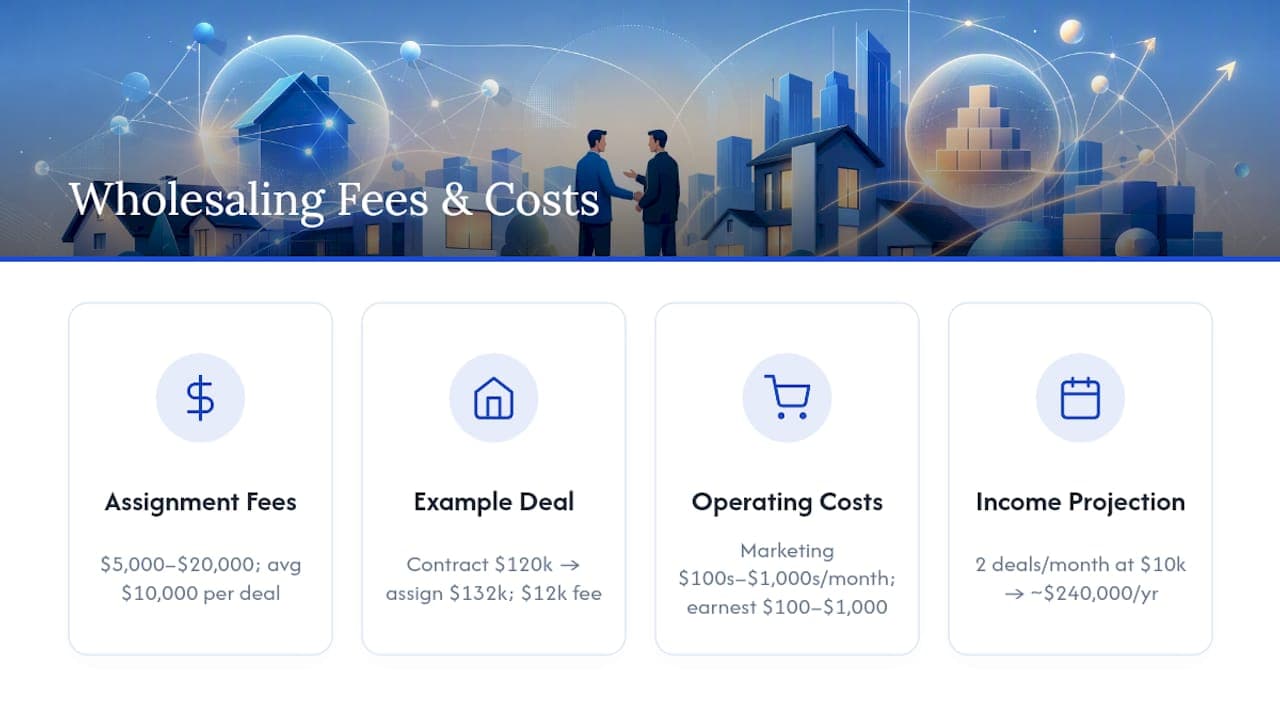
Assignment fees typically fall between $5,000 and $20,000, with many operators averaging closer to $10,000 per deal, depending on the property, market, and how motivated the buyer is. A wholesaler who locks a distressed three-bedroom under contract for $120,000 and assigns it to an investor for $132,000 pockets a $12,000 fee at closing, no repairs or renovation required.

That number looks appealing until you count what it costs to generate. Marketing typically runs several hundred to a few thousand dollars a month, earnest money deposits commonly range from $100 to $1,000 per contract, and legal or title review fees add up across a year of deals. Annual income depends far more on how many offers you make and how many actually close than on the size of any single fee. A wholesaler closing two deals a month at $10,000 each clears roughly $240,000 a year before expenses; someone closing two deals a year clears a fraction of that while paying the same marketing bills.
Why Wholesale Deals Fall Apart
Most rejected offers never turn into contracts, and most signed contracts never find a buyer in time. That’s the uncomfortable math beginners often miss.
- Marketing spend can outpace closed deals for months before your buyer list and seller pipeline mature.
- Skipping inspection or financing contingencies means forfeiting earnest money if you can’t assign the contract in time.
- Weak buyer lists cause the most missed deadlines. No amount of seller marketing fixes a thin roster of ready cash buyers.
- Misrepresenting your role to a seller, implying you’re the actual buyer when you plan to assign, invites both legal exposure and reputational damage.
Full disclosure to sellers about your intent to resell the contract isn’t optional ethics. It’s often the exact language regulators expect to see in writing.
Your First 90 Days: A Realistic Wholesaling Checklist
Buyers close deals, not seller leads. Before you even market for a property, build a list of cash buyers, local investors, and rehab flippers who can move fast when you bring them a contract. Investor meetups, local real estate investment association chapters, and public auction records are all reasonable places to recruit them. Vet each buyer by asking about proof of funds and past closings before you count on them.
- Weeks 1 to 3: Build your buyer list first. Attend one local investor meetup, pull proof-of-funds letters, and confirm at least ten active buyers before you start marketing to sellers.
- Weeks 4 to 6: Run low-cost lead tests. Driving for dollars costs almost nothing but time; direct mail to a small distressed-property list typically runs a few hundred dollars; both beat expensive paid ads for a first campaign.
- Weeks 7 to 10: Assemble your paperwork. Get a purchase agreement with an assignment clause reviewed by an attorney, and pick a title or escrow partner comfortable closing wholesale transactions.
- Weeks 11 to 13: Make offers with firm contingency windows, typically 7 to 14 days for inspection, and track every offer’s outcome.
Pro Tip: Track cost per lead and offers-to-closed-deals from day one. Those two numbers tell you faster than anything else whether your marketing channel or your buyer list is the weak link.
What Sellers Should Know About Fast, As-Is Sale Marketplaces
Not every distressed seller wants to negotiate with a wholesaler hunting for an assignment fee. A marketplace model, where a homeowner receives multiple vetted cash offers directly, skips that middle layer entirely. Housegoodbye connects Michigan homeowners with competing local investors who bid on the property as-is, with closings possible in as little as seven days.
- No repairs, staging, or agent commissions required before an offer comes in.
- Multiple competing bids tend to push offers higher than a single wholesaler’s take-it-or-leave-it number.
- Transparent bidding means sellers see who’s offering what, rather than trusting one buyer’s word about market value.
For sellers who value speed and clarity over the smallest possible middleman fee, a cash closing process with several bidders can be the safer route.
Beyond Assignment: Transactional Funding and Simultaneous Closings
Assignment and the standard double close aren’t the only ways to structure an exit. When an assignment fee would be unusually large, some buyers balk at seeing that number on paperwork, and a double close hides the markup by treating the transaction as two separate sales.
Double closes require actual funds to purchase the property, even for a few hours, and that’s where transactional funding comes in. Short-term lenders provide same-day capital that covers the A-to-B purchase, secured by the simultaneous B-to-C sale already lined up with your end buyer. The wholesaler repays the loan, often with a flat fee or a few points of interest, the moment the second closing funds. This only works when both closings are scheduled back to back, sometimes literally hours apart, with title and escrow coordinating the timing precisely.
Simultaneous closings carry their own risk: if the B-to-C sale falls through after you’ve already funded the A-to-B purchase, you own the property and the transactional loan comes due regardless. That’s why experienced operators only use this structure once the end buyer’s financing or proof of funds is fully verified, not just promised.
Some wholesalers also structure exits through joint ventures with a rehabber, taking a smaller upfront fee plus a share of the eventual flip profit. It’s less common because it ties your payday to someone else’s renovation timeline, but it can work when a property needs more capital than any single cash buyer wants to commit alone.
Building Relationships With Sellers and Buyers That Actually Last
Wholesaling runs on trust moving in two directions at once. Sellers need to believe you’ll do what you say, and buyers need to believe your deals are priced honestly and closed on schedule.
With sellers, that starts with transparency about your role. Telling a homeowner upfront that you may assign the contract to another buyer, rather than purchasing it yourself, avoids the single most common ethical complaint against wholesalers. Following through on timelines matters just as much. A seller who’s told closing happens in ten days and then waits three weeks won’t refer you to a neighbor, and word travels fast in distressed-property circles.

With buyers, consistency is the currency. Investors who get burned by inflated ARV estimates or hidden repair costs stop answering your calls. The wholesalers who build repeat buyer relationships tend to underpromise on condition and overdeliver on documentation, sharing repair estimates, comps, and inspection notes upfront rather than making buyers dig for them. A property condition assessment that’s accurate from the first conversation saves everyone time later.
Treat your buyer list like a client roster, not a spreadsheet you email once. Regular check-ins about what each buyer is currently looking for, whether they’ve shifted from single-family flips to small multifamily, mean you can match a contract to the right buyer within hours instead of blasting your entire list and hoping.
Staying on the Right Side of Marketing Rules
How you advertise a property you don’t own is where a lot of wholesalers get into trouble without realizing it. Listing a home on the open market, or in ways that mimic a licensed brokerage, before you actually hold an equitable interest under contract, can cross into unlicensed brokerage activity in several states.
The safer practice is straightforward: only market a property once you have a signed contract giving you an equitable interest in it, and be explicit in your marketing that you’re advertising an interest in a contract, not acting as the property’s listing agent. Avoid language that implies you’re a licensed real estate professional if you’re not one.
Ethical marketing extends to how you approach sellers, too. Aggressive scripts designed to pressure a financially distressed homeowner into signing quickly, without giving them time to understand what an assignment fee means for their bottom line, are the kind of practice that draws regulatory attention and, more importantly, causes real harm to people already in a hard spot. Full disclosure of your intent to resell the contract for profit should appear in the contract itself, not just in a verbal conversation that’s easy to dispute later.
Software and Tools That Make Wholesaling Manageable
Running seller leads, buyer contacts, and contract deadlines through a notebook or a scattered set of spreadsheets is how deals slip through the cracks. Customer relationship management platforms built for real estate investors let you track every seller conversation, tag leads by motivation level, and set automated follow-up reminders so a promising lead never goes cold from neglect.
Skip tracing tools help you find current contact information for absentee owners and out-of-state heirs, often the most motivated sellers in any market. Comparable-sales platforms speed up ARV estimates, cutting down the time between seeing a property and calculating a defensible offer. Direct mail automation services handle print and postage for postcard or letter campaigns without you managing a print shop relationship. And e-signature platforms let sellers and buyers execute contracts remotely, which matters when your buyer pool spans multiple counties or states.
None of these tools replace the actual due diligence work. A step-by-step due diligence process still matters regardless of what software tracks your pipeline, but the right stack turns wholesaling from a chaotic hustle into something you can actually run like a small business.
Negotiating Wholesale Deals Without Burning Bridges
Negotiating with a motivated seller is different from negotiating with a cash buyer, and treating both conversations the same way is a common beginner mistake.
With sellers, the goal isn’t to squeeze the lowest possible price. It’s to arrive at a number that still leaves room for a buyer’s profit while genuinely solving the seller’s problem, whether that’s speed, avoiding foreclosure, or skipping repairs entirely. Anchoring the conversation around their actual need, not just the price, tends to produce better terms than a hard-nosed lowball. A seller who feels heard is far more likely to accept contingencies you’ll need later.
With buyers, the leverage shifts. Your job is to demonstrate that your assignment fee reflects a genuinely well-priced deal, backed by real comps and honest repair estimates, rather than padding your number and hoping a buyer doesn’t check. Buyers who catch inflated numbers once rarely take a second call. Framing your fee transparently, showing your math instead of hiding it, tends to close faster than negotiating from a defensive posture.
A Practitioner’s View on What Actually Separates Winners From Quitters
Wholesaling is a lead-generation and sales business wearing a real estate costume. The people who last treat it like running a small marketing company: consistent systems, a real buyer network, disciplined compliance, and marketing spend they actually track. Everyone else burns a few hundred dollars on postcards, gets no callbacks, and quits. Test small, measure cost per lead against offers per closed deal, and let the numbers tell you whether to scale or pivot.
— Bryan
A Faster, More Transparent Option for Homeowners Who Just Want Out
If you’re a Michigan homeowner reading all this and thinking the wholesaling route sounds like a lot of legal risk for someone else’s profit, you’re not wrong to want a simpler path. Housegoodbye puts your property in front of multiple vetted local investors at once, so instead of accepting one wholesaler’s single lowball number, you get competing cash offers and pick the best one.

There’s no need to fix anything, stage a single room, or pay agent commissions, and qualifying homes can close in as little as seven days. That matters most when you’re facing foreclosure, an inherited property you can’t maintain, or a relocation deadline that won’t wait for a traditional listing. Sellers dealing with code violations or deferred repairs often find this route faster than trying to find and vet a wholesaler on their own. If you want to see what your home could sell for without listing it, start with an as-is offer comparison and see the bids for yourself.
This article is general information, not a substitute for advice from a qualified financial advisor. Consult a qualified financial professional about your own circumstances before acting on anything here.
Sources
- Wholesaling - National REIA
- Real Estate Wholesaling Explained: How It Works, …
- Landwholesalinglaws
- Real Estate Wholesaling: The Honest Truth About America’s Most Hyped Hustle – MakeMeRich
FAQ
Is Wholesaling Real Estate Worth It?
It can be worth it for people willing to treat it as a sales and marketing business, since assignment fees often fall between $5,000 and $20,000 per deal, but income depends heavily on deal volume, not just fee size.
What Is the 70% Rule in Wholesaling?
The 70% rule is a quick screening guideline: offer no more than 70% of a property’s after-repair value minus estimated repair costs, leaving room for your fee and the buyer’s profit.
How Much Money Can You Make Wholesaling Real Estate?
Individual assignment fees commonly average near $10,000, so annual income scales mainly with how many deals you close each year rather than the size of any single fee.
What Is Real Estate Wholesaling?
Real estate wholesaling is contracting to buy a property, then either assigning that contract to a cash buyer for a fee or briefly taking title through a double close before reselling it.
Do I Need a License to Wholesale Real Estate?
Requirements vary significantly by state, with some allowing simple contract assignment and others requiring disclosures, licensing thresholds, or a double close instead, so checking your state’s current rules or consulting a local real estate attorney before your first deal is essential.