The fastest reliable way to sell a marital home during divorce in the Sterling Heights and Detroit area is a competitive cash-offer marketplace like HouseGoodbye, which collects multiple vetted investor bids so you sell as-is, skip agent fees, and can potentially close in about seven days. Before you accept anything, check with your attorney for any court orders restricting the sale and confirm both spouses are legally cleared to sign.
TL;DR:
- Using a cash marketplace like HouseGoodbye allows a divorce sale to close in about a week, with no repairs or agent commissions required.
- Both spouses must typically sign all sale documents, or the court can order a sale if one spouse refuses, which adds weeks or months to the process.
- Sale proceeds are held in escrow until court orders or settlement agreements determine division, and the final deed must be recorded to clear the title legally.
- A court-ordered sale is often necessary when spouses cannot agree, with timelines ranging from six months to over a year depending on court deadlines and refinancing attempts.
- A quick, cooperative cash sale bypasses common delays caused by disagreements, liens, or procedural errors, providing faster access to funds and legal clarity.
Table of Contents
- Divorce House Sale Detroit: Which Fast-Sale Option Fits You?
- Do Both Spouses Have to Sign the Sale Documents?
- How Do You Protect Sale Proceeds and Follow Court Orders?
- How Long Does a Divorce House Sale Actually Take in Detroit?
- What if My Spouse Delays or Disputes the Sale?
- Will Selling During Divorce Trigger Taxes in Michigan?
- Should You Hire a Divorce-Specialized Agent or Attorney?
- What Happens if You and Your Spouse Disagree on Value?
- How Do Michigan Market Conditions Affect Your Sale Speed?
- A Local Perspective on What Actually Slows Divorce Sales Down
- Get Multiple Cash Offers Through HouseGoodbye
- Legal Resources Worth Bookmarking
- Sources
- FAQ
Divorce House Sale Detroit: Which Fast-Sale Option Fits You?
Speed and net proceeds usually pull in opposite directions, and knowing that trade-off up front saves you weeks of frustration. A divorce house sale in the Detroit area typically comes down to four realistic paths, each with its own timeline and paperwork burden.
Cash buyer marketplaces move fastest because there’s no lender underwriting, no repair negotiations, and no staging delay. You take the property as it sits, review competing bids, and pick the one with the best combination of price and timeline. That structure matters more in a divorce than in an ordinary sale, since fewer moving parts means fewer chances for one spouse to stall the process.
Listing with an agent on the MLS can net a higher sale price, but it comes with prep work, showings, commission (typically a standard real estate commission), and a closing timeline that often runs 30 to 60 days or longer once financing contingencies enter the picture.
A buyout, where one spouse keeps the house and refinances the mortgage into their own name, avoids a sale entirely but only works if that spouse can qualify for financing alone.
When spouses can’t agree, a judge can order the sale directly under Michigan Compiled Laws — MCL 552.401, which gives circuit courts broad authority to divide or order sale of property “as appears equitable.”
- Cash marketplace: fastest close, as-is condition, no commissions
- Agent/MLS: higher ceiling price, slower timeline, prep and commission costs
- Buyout: no sale needed, but requires solo refinance qualification
- Court-ordered sale: used only when spouses can’t agree, timeline set by the judge
Minor repairs (a leaking faucet, patchy paint) rarely pay off before a divorce sale. Save the money and the time.
Do Both Spouses Have to Sign the Sale Documents?
Yes. If the home is jointly owned, both spouses normally must sign the listing agreement, the purchase contract, and every closing document, regardless of who moved out or who is paying the mortgage. There’s no legal workaround for a jointly titled property, according to guidance from The Patrick Group, which flags this as one of the most common reasons Michigan divorce sales stall.
If one spouse refuses to sign, cooperatively selling stops being an option. The other spouse’s only path forward is asking the court to order the sale, which puts the decision in a judge’s hands rather than a negotiation between exes. That process adds weeks, sometimes months, depending on your circuit court’s docket.
This is why Sterling Heights sellers benefit from settling signature logistics early rather than after an offer arrives. If you already know your spouse is cooperative, get written confirmation from your attorney that both parties intend to sign, so a buyer’s timeline doesn’t collapse mid contract. If cooperation is doubtful, raise the possibility of a court-ordered sale with your attorney before you list or solicit offers, so you aren’t caught negotiating a deal that legally can’t close.
A buyer, cash or financed, will walk if signatures don’t materialize on schedule. Vetted cash buyers tend to have more flexibility here because they aren’t juggling a mortgage lender’s own closing deadline.
How Do You Protect Sale Proceeds and Follow Court Orders?
Escrow is your safety net. When spouses sell before the divorce is finalized, Michigan Legal Help notes that proceeds are commonly held in escrow rather than distributed to either spouse, until the court or a settlement agreement decides how to divide them.
Before you list or accept any offer, confirm there’s no active “status quo” order or asset freeze in your case file. Violating one, even accidentally, by selling or moving funds without authorization can trigger sanctions and blow up your closing date.
Once a judge awards the property to one spouse in the final decree, that decree carries the same legal weight as a quitclaim deed. But the title doesn’t update itself. The other spouse still has to sign an actual quitclaim deed, and that deed has to be recorded with the county register of deeds before the title is genuinely clear, a step confirmed in Michigan Legal Help’s guidance on quitclaim deeds and divorce.

Sequence matters here. A clean process usually runs: attorney confirms no restraining order exists, both spouses sign the purchase agreement, closing proceeds route into escrow, and the quitclaim deed gets signed and recorded either at closing or shortly after, depending on how your decree is written. Skipping the recording step is the single most common reason titles stay muddy months after a sale supposedly closed.
How Long Does a Divorce House Sale Actually Take in Detroit?
From the decision to sell to a closed transaction, expect anywhere from one week to several months, and the biggest variable isn’t the real estate market. It’s spousal cooperation.
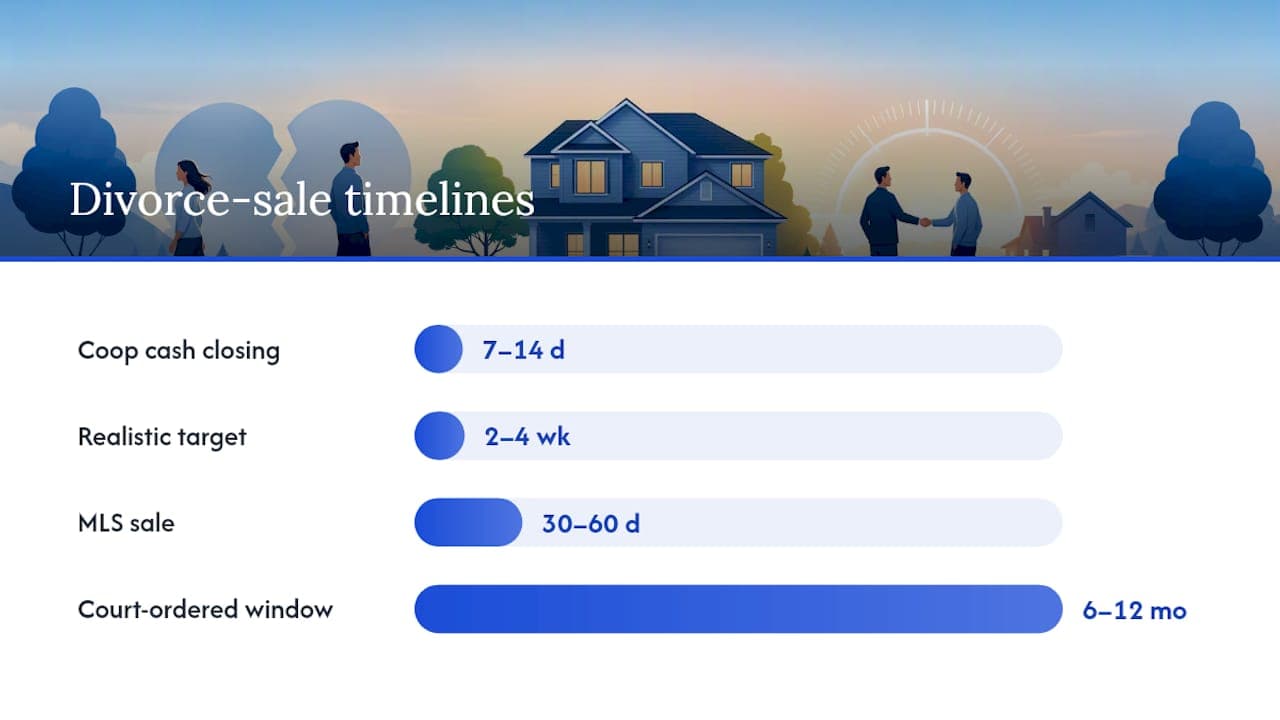
A cash-offer path with two cooperative signers can move from initial bids to closing in roughly seven to fourteen days. That’s the outer edge of fast, and it depends on clear title, no outstanding liens, and no court restrictions in play.
An MLS listing adds 30 to 60 days on top of that for showings, negotiations, inspection contingencies, and mortgage underwriting if the buyer isn’t paying cash.
Court-ordered sales run on a different clock entirely. Judges sometimes build deferred-sale windows into a decree, commonly six to twelve months, to give a spouse time to refinance and buy out the other, according to Divorce. If that refinance attempt fails, the sale process restarts from there.
Pro Tip: Ask your attorney to check the decree’s language on sale deadlines before you list. Some Michigan decrees set a hard date for listing the home if a buyout attempt stalls, and missing that date can trigger contempt proceedings.
For most Sterling Heights sellers who want out cleanly and quickly, the realistic target is two to four weeks from first offer to funds in escrow, assuming both spouses sign promptly and no liens surface during title search.
What if My Spouse Delays or Disputes the Sale?
Delay tactics are common, and they usually fall into a few patterns: refusing to sign, disputing the listing price, blocking showings, or simply going silent. Each has a different fix.
If your spouse won’t sign anything, your attorney can petition the court for an order compelling the sale under MCL 552.401’s broad equitable authority. This takes time, but it removes the veto power entirely.
If the dispute is over price, an independent appraisal often settles it faster than continued negotiation. Both spouses agreeing in writing to accept whatever a licensed appraiser determines removes the emotional back-and-forth from the equation.
If your spouse is simply unresponsive, written offers with firm deadlines create pressure that vague conversations don’t. A cash buyer’s offer that expires in 48 or 72 hours forces a decision in a way an open-ended MLS listing never does.
Document everything. Text messages, emails, and mortgage payment records all matter later, particularly since local family-law guidance points out that unequal payments during separation can affect how proceeds get divided. Keeping a paper trail from day one protects you if the dispute ends up in front of a judge.
Will Selling During Divorce Trigger Taxes in Michigan?
Most Sterling Heights sellers won’t owe federal capital gains tax on the sale of a primary residence, thanks to the IRS home sale exclusion, which allows up to $250,000 in gain to be excluded for a single filer or $500,000 for a married couple filing jointly, provided you’ve owned and lived in the home for at least two of the last five years.
Divorce complicates the “married filing jointly” piece. If your divorce finalizes before the sale closes, you may each qualify only for the $250,000 individual exclusion rather than the $500,000 joint exclusion, depending on timing and how the decree characterizes the sale. This is a detail worth reviewing with a tax professional or your divorce attorney before you set a closing date, not after.
Michigan doesn’t add a separate state-level real estate transfer gains tax beyond the standard state and county transfer taxes paid at closing, which are typically the seller’s responsibility unless the purchase agreement says otherwise.
Marital debt also factors in before taxes ever apply. That order of operations, debt first, division second, is worth confirming with your attorney so you know what you’re actually walking away with.
Should You Hire a Divorce-Specialized Agent or Attorney?
If you go the listing route instead of a cash marketplace, an agent who’s handled divorce sales before is worth seeking out specifically. They know how to navigate two decision-makers who may not agree, how to structure showings when one spouse still lives in the home, and how to keep both parties informed without becoming a mediator themselves.
Ask a candidate agent directly how many divorce transactions they’ve closed in the past year and how they handle disagreements over listing price. A vague answer is a red flag.
On the legal side, a family-law attorney experienced with real estate closings, not just custody and support, catches the details that generic divorce attorneys sometimes miss: escrow instructions, deed recording timing, and whether your decree’s language actually authorizes a sale or just recommends one. Oakland County family-law guidance specifically flags signature and appraisal disputes as the most frequent causes of delay, which tells you where to focus your questions when interviewing counsel.
If your priority is speed over maximizing sale price, a cash marketplace sidesteps much of the agent-selection process entirely, since there is no listing strategy to coordinate.
What Happens if You and Your Spouse Disagree on Value?
Valuation disputes are one of the most predictable friction points in a divorce sale, and they’re also one of the easiest to resolve if you handle them early. If one spouse thinks the home is worth $320,000 and the other insists on $280,000, that $40,000 gap can stall a sale for weeks while both sides dig in.
The standard fix is a licensed, independent appraisal, ideally one both spouses agree in advance to accept as binding. Courts often order this directly when spouses can’t settle the number themselves, and an appraiser’s report carries far more weight in negotiations, or in front of a judge, than either spouse’s personal estimate.
A second option is getting competing cash offers before ordering a formal appraisal. Multiple investor bids on the same property, gathered through a marketplace, give you real market feedback without paying appraisal fees upfront. If the offers cluster near a number both spouses can live with, that often resolves the dispute faster and cheaper than a court-ordered appraisal.
Either way, don’t let a valuation disagreement freeze the whole process. Get a number on the table, whether from an appraiser or from real bids, and move the conversation from opinion to evidence.
How Do Michigan Market Conditions Affect Your Sale Speed?
Sterling Heights and the broader Metro Detroit market have run tight on inventory for the past several years, which generally favors sellers on price but doesn’t necessarily speed up traditional closings. Financed buyers still need appraisals, inspections, and loan underwriting, and that process moves at the same pace regardless of how hot the market is.
Seasonal timing matters too. Listings that go live in spring and early summer typically see faster buyer interest across Southeast Michigan, while winter listings sit longer, an important factor if your decree has a sale deadline built in.
Cash marketplaces largely sidestep both issues. Because investor buyers aren’t waiting on mortgage approval, a competitive cash-offer process can close on a similar timeline in January as in June. For a divorce sale where the calendar is set by a court order rather than the housing market, that consistency is often more valuable than chasing peak-season pricing.
A Local Perspective on What Actually Slows Divorce Sales Down
The pitfalls I see repeated in Sterling Heights divorce sales aren’t really about the real estate market. They’re procedural: a deed that never got signed, a lien nobody checked for until closing week, or a status quo order buried in the case file that neither spouse remembered existed.
Single-offer investor deals tend to produce lowball numbers because there’s no competitive pressure. A marketplace structure that surfaces multiple vetted bids fixes that by letting market pressure, not one buyer’s opening number, set the price. When both spouses have written, cash-backed offers to compare and their attorney reviewing terms before signing, closings move faster and with fewer surprises at the table.
— Bryan
Get Multiple Cash Offers Through HouseGoodbye
If you’re weighing an agent listing against a court-ordered timeline, there’s a third path that skips both headaches: HouseGoodbye gathers multiple competing cash offers from vetted local investors, so you sell as-is with no repairs, no staging, and no agent commission cutting into your share of the proceeds.

That competitive structure matters specifically in divorce sales, where speed and clean paperwork often outweigh chasing the absolute top dollar. Offers are written and cash-backed, which can give your attorney something concrete to review before either spouse signs, and the process can support closing in as little as seven days once both signatures and escrow instructions are in place.
To get started, gather your mortgage payoff statement, current title documents, and a copy of any court order affecting the sale. Then request offers through HouseGoodbye’s fast-sale process and compare real bids before you commit to anything.
Legal Resources Worth Bookmarking
For the statute governing court authority over property division, read MCL 552.401 directly. Michigan Legal Help’s real estate and divorce guide covers escrow and pre-judgment sales in plain language. For local practitioner insight, Oakland County family-law guidance walks through common closing snags. If you’re ready to request offers, HouseGoodbye’s Detroit-area landing page explains the local process.
This article is general information, not a substitute for advice from a qualified lawyer. Consult a qualified legal professional about your own circumstances before acting on anything here.
Sources
- Michigan Compiled Laws — MCL 552.401
- Real estate and divorce | Michigan Legal Help
- Selling the House During Divorce in Oakland County, Michigan
FAQ
Can You Sell a House During a Divorce in Michigan?
Yes, a marital home can be sold before the divorce is finalized if both spouses agree, or if a judge authorizes the sale, according to Michigan Legal Help. Proceeds are commonly held in escrow until the divorce settlement or decree determines how they’re divided.
Do Both Spouses Have to Agree to Sell the House?
For a jointly owned home, both spouses generally need to sign the listing, purchase, and closing documents. If one refuses, the other spouse’s only recourse is asking the court for a sale order under MCL 552.401, which grants judges broad authority to order a sale as equity requires.
How Fast Can You Sell a House During a Divorce?
A cash-offer marketplace can potentially close in as little as seven days, according to HouseGoodbye, since there’s no lender underwriting or repair negotiation involved. An agent-listed sale typically takes 30 to 60 days or longer once financing contingencies and showings are factored in.
Who Pays the Mortgage While the House Is Being Sold?
This depends on your temporary support order or informal agreement, but whoever is living in the home or named in the decree’s interim terms usually covers payments until closing. Documenting who pays what during separation matters, since uneven payments can affect the equitable division of remaining proceeds.
Does HouseGoodbye Handle Divorce-Related Home Sales?
Yes, HouseGoodbye’s marketplace model, gathering multiple competing cash offers for an as-is sale, works well for divorce situations where both spouses want speed and clear paperwork. Pricing for its services isn’t published; homeowners submit their property details on the HouseGoodbye site to receive offers directly.