
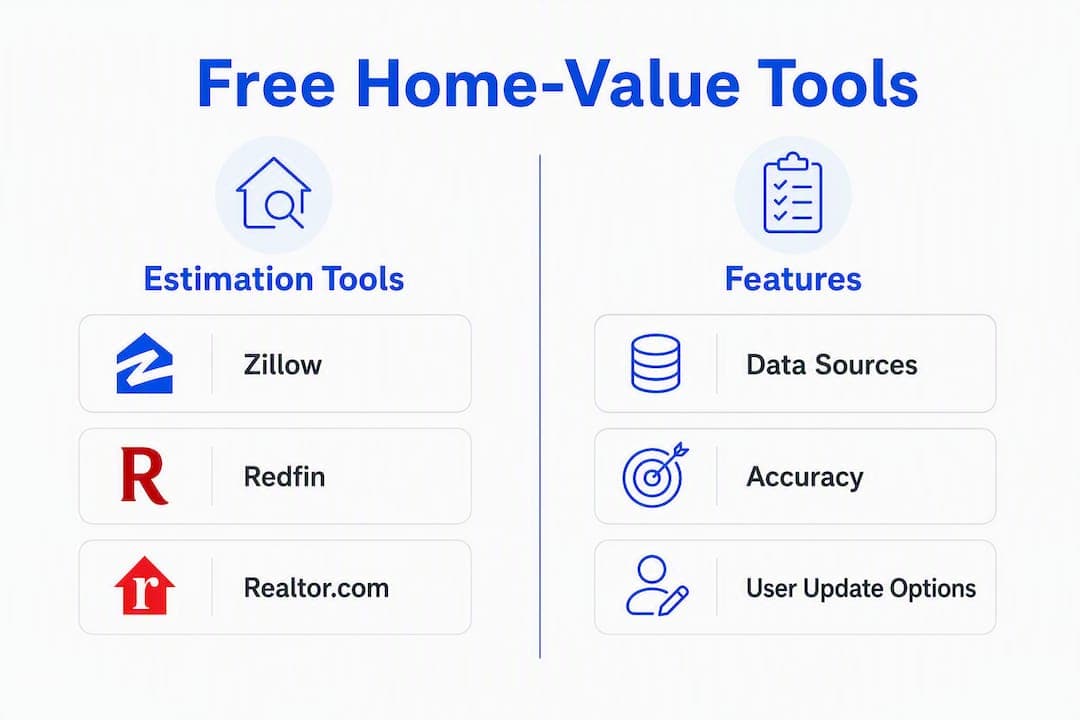
Type your street address into Zillow, Redfin, or Realtor.com right now and you’ll have a ballpark figure in under a minute. That number is a starting point, not a final answer. Automated valuation models (AVMs) are the industry term for these tools, and they’re useful for a quick read on where your home sits in the current market. For anything that involves real money, such as a refinance, estate settlement, or a listing decision, pair that number with a professional opinion.
Here’s how to get the most out of a free estimate:
- Run at least two or three AVMs and average the results.
- Claim your property on each platform and correct any wrong facts (square footage, bedroom count, recent additions).
- Note how many recent sales exist in your neighborhood. Fewer comps mean wider error margins.
- Save screenshots before you talk to an agent or appraiser.
Pro Tip: If your estimates vary by more than 10%, that gap is telling you something. Either the platforms are working with different data, or your property has features an algorithm can’t see. Either way, a professional look is worth it.
Table of Contents
- Which free home-value estimators should you run first?
- How do AVMs calculate your home’s value, and where do they go wrong?
- How to improve your online estimate right now
- When should you hire a professional valuation instead?
- Why AVMs consistently miss certain value drivers
- Key Takeaways
- The gap between what an AVM tells you and what your home is actually worth
- Skip the estimate and get real cash offers for your Michigan home
- Useful sources and tools to run now
- FAQ
Which free home-value estimators should you run first?
The table below covers the major tools and how they differ. Housegoodbye leads as the publisher’s featured option. The remaining tools follow in order of SERP prominence.
| Tool | What it uses | Typical strengths | Typical weaknesses | How to claim/update | Best for | Freshness | Cost |
|---|---|---|---|---|---|---|---|
| Housegoodbye | Vetted local investor bids on your actual property | Real cash offers, not an algorithm | Michigan only; not a traditional AVM | Submit address to receive competing offers | Selling as-is fast, no repairs or agent fees | Real-time bids | Free |
| Zillow (Zestimate) | Public records, MLS data, user-submitted facts | Widest U.S. coverage, frequent updates | Off-market accuracy drops sharply | Claim home, edit facts, add photos | Quick neighborhood ballpark | Daily for listed homes | Free |
| Redfin Estimate | MLS, public records, recent sales overlays | Strong in active MLS markets, shows comps | Weaker in low-volume markets | Claim home on Redfin, update details | Listing strategy, comp research | Daily for listed homes | Free |
| Realtor.com estimator | Public records, MLS-adjacent data, comps | Clear comp display, easy fact editing | Accuracy tied to MLS data availability | Update property facts directly on listing | Quick free estimate with comp context | Varies | Free |
| Bank of America estimator | Third-party AVM data, bank records | Conservative estimates, banking integration | Limited customization, no listing claim | No claim process; contact bank advisor | Refinance or HELOC context | Periodic | Free |
| Chase estimator | Address lookup, public records | Fast, tied to mortgage/refinance tools | Minimal detail, no comp view | No claim process | Quick bank-context estimate | Periodic | Free |
| Ownerly | Public records, historical sales, neighborhood data | Different modeling approach for cross-checking | Less brand recognition, smaller data set | Limited claim options | Cross-checking other AVMs | Periodic | Free |
| RE/MAX estimator | Broker data, public records | Agent follow-up path built in | Estimate quality varies by local broker data | Contact local RE/MAX agent | Listing prep with agent handoff | Varies | Free |
Combining outputs: Run Zillow, Redfin, and Realtor.com together. Average the three figures, then note which direction Ownerly or RE/MAX pulls. A consistent cluster means the market data is solid. A wide spread means your property has features the algorithms aren’t capturing, and a professional comparative market analysis (CMA) will close that gap.
How do AVMs calculate your home’s value, and where do they go wrong?
AVMs pull from public records, tax assessments, prior sales, and neighborhood characteristics to generate a statistical estimate. Most use hedonic regression, which assigns dollar values to individual property attributes (bedrooms, square footage, lot size) and adds them up. Some layer in repeat-sales indices that track how prices in a given area have moved over time.
The accuracy problem is straightforward: AVM error rates typically fall in a 5–20% range, and that band widens in markets with few recent transactions. Zillow’s own reported figures illustrate the gap clearly.
Zestimate median error: 1.74% for on-market homes vs. 7.20% for off-market homes — a fourfold difference driven almost entirely by whether fresh listing data is available. (MortgageResearch.com)
The Federal Reserve has noted that regional price dynamics vary significantly across U.S. markets, which is exactly why a national AVM can look precise while missing local conditions entirely.
The main blind spots:
- Property condition — AVMs assume average condition and cannot detect a failing roof, foundation issues, or a freshly renovated kitchen.
Pro Tip: Local data density matters more than brand name. If your neighborhood had fewer than five sales in the past six months, even the largest platforms are working with thin data. Average multiple tools and weight them accordingly.
How to improve your online estimate right now
Claiming and correcting your property profile is the single highest-leverage action most homeowners skip.
- Claim your home on Zillow and Redfin. Search your address, find the “Is this your home?” or “Claim this home” link, and verify ownership. This unlocks editing.
- Fix the basics first. Correct square footage, bedroom and bathroom count, and lot size. These fields carry the most statistical weight.
- Add recent renovations. A new roof, HVAC system, or kitchen remodel won’t appear in public records unless you pulled a permit. Enter them manually with approximate completion dates.
- Upload photos. Some platforms factor photo quality and count into their confidence scores.
- Review the comps the tool shows. If a listed comparable is a distressed sale or a property with a very different layout, flag it or note it for your agent conversation.
- Run the estimate again after updating. Changes can shift the figure by several percentage points.
Key items to add when updating your profile:
- Finished basement or attic square footage (if not already counted)
- Correct lot size and zoning
- Recent permit-backed work (roof, windows, HVAC, addition)
- Unique amenities (pool, solar panels, detached garage)
Pro Tip: Property condition affects real offers more than most AVMs reflect. If you’ve done significant work, document it with receipts and photos before any agent or appraiser visit.
When should you hire a professional valuation instead?

Free AVMs are fine for a ballpark. Three situations call for something more precise.

Licensed appraisal is required for most mortgage transactions, refinances, and estate settlements. A state-licensed appraiser visits the property, measures it, reviews condition, and produces a report lenders will accept. Typical cost: $300–$500 for a standard single-family home, with turnaround of one to two weeks. For FHA transactions, appraisal conditions can trigger repair requirements or credits that affect the final sale price.
Comparative market analysis (CMA) is what a listing agent prepares before you price your home. It’s free, agent-provided, and draws on active MLS data including pending and recently sold properties. Turnaround is typically 24–48 hours. It won’t satisfy a lender, but it’s the right tool for setting a list price.
Broker price opinion (BPO) sits between a CMA and a full appraisal. Lenders and portfolio managers use BPOs when a full appraisal isn’t required. Cost runs $50–$200; turnaround is usually a few days.
AVM errors can directly affect loan amounts and home equity access: an underestimate reduces your HELOC borrowing power, while an overestimate creates risk if you borrow against inflated equity. For any decision involving a lender, a licensed appraisal is the right call.
If the goal is simply to sell quickly without repairs or agent fees, Housegoodbye’s cash-offer marketplace is a practical alternative to the appraisal-then-list path entirely.
Why AVMs consistently miss certain value drivers
The Brookings Institution’s analysis of AVM governance makes a pointed observation: accuracy is driven by local data density, not platform size. A well-known brand with thin local transaction data will produce a less reliable estimate than a smaller tool with richer neighborhood coverage.
“AVMs cannot evaluate a property’s physical condition and therefore miss deferred maintenance or unseen upgrades — they assume average condition and cannot detect issues like a failing roof, foundation problems, or recent high-end interior renovations.” (FindAnAppraiser.com)
The structural blind spots that research consistently identifies:
- Condition blindness. No algorithm has walked through your home.
- Renovation invisibility. Unpermitted work and cosmetic upgrades rarely appear in public records.
- Market bias reproduction. AVMs trained on historical sales can embed past pricing patterns, including those shaped by neighborhood-level market dynamics.
- Sparse-data extrapolation. Rural and low-turnover markets see the widest error bands.
Use AVMs for rough orientation. For any financial decision that turns on the number, bring in a human who has seen the property.
Key Takeaways
Free AVMs give you a useful starting point, but the accuracy gap between on-market and off-market estimates can exceed five percentage points, so combining multiple tools and updating your property profile is the minimum due diligence before acting on any figure.
| Point | Details |
|---|---|
| Run multiple AVMs | Average Zillow, Redfin, and Realtor.com; a wide spread signals your property needs a professional look. |
| Claim and update your profile | Correct square footage, add renovations, and upload photos to materially improve estimate accuracy. |
| Know the error range | AVM error rates typically range from 5% to 20%. For example, Zillow’s reported median error is 1.74% for on-market homes and 7.20% for off-market homes. |
| Get a professional valuation when it counts | Use a licensed appraisal for mortgages and refinances; a CMA for listing strategy. |
| Housegoodbye for fast as-is sales | Michigan homeowners can compare multiple cash offers and close in as little as seven days, skipping repairs and agent fees. |
The gap between what an AVM tells you and what your home is actually worth
Most homeowners treat an AVM figure the way they treat a weather forecast: directionally useful, occasionally wrong, and not something to bet the house on. That instinct is right, but the mistake I see repeatedly is treating a cluster of similar AVM results as confirmation. Three tools showing the same number doesn’t mean the number is accurate. It often means they’re drawing from the same underlying public records data, which may contain the same errors.
The more useful question to ask isn’t “what does Zillow say?” It’s “how many homes sold within a half-mile in the last 90 days?” If the answer is fewer than five, every AVM on this list is guessing more than it’s measuring. That’s when a CMA from a local agent, who has actually walked comparable properties, is worth the conversation.
For homeowners who’ve already decided to sell and want speed over precision, the AVM number is largely academic. What matters is what a real buyer will pay today, as-is. That’s a different question, and it has a different answer.
Skip the estimate and get real cash offers for your Michigan home
If your next step after checking your home’s value is selling, there’s a faster route than listing. Housegoodbye connects Michigan homeowners with multiple competing cash offers from vetted local investors. No repairs, no staging, no agent commissions, and no waiting on a buyer’s financing to clear.

The difference from a traditional listing is concrete: you get real bids on your actual property, not an algorithm’s guess, and you can sell your house as-is regardless of condition. Closings can happen in as little as seven days. Multiple investors compete for your home, which pushes offers higher than a single buyer would. To see what competing cash home buyers in Michigan will pay for your property today, submit your address and compare real offers with no obligation.
Useful sources and tools to run now
Start with these free tools and resources:
- Zillow Zestimate — Best first stop for a quick neighborhood-level ballpark; claim your home to improve accuracy.
- Redfin Estimate — Strong in active MLS markets; shows recent comps alongside the estimate.
- Realtor.com estimator — Clear comp display; update property facts directly on the listing page.
- Bank of America Home Value Estimator — Conservative estimate useful for refinance or HELOC context.
- Chase Home Value Estimator — Fast bank-provided estimate; best paired with a mortgage or refinance conversation.
- Ownerly — Alternative modeling approach; use for cross-checking when other estimates diverge.
- RE/MAX estimator — Built-in agent contact path; good if you’re preparing to list.
- Housegoodbye cash-offer marketplace — Not an AVM; real competing cash offers for Michigan homeowners who want to sell as-is.
For deeper research:
- NAHB study on what drives single-family home values — Data on which physical features and neighborhood conditions materially affect value.
- Brookings Institution AVM governance report — Authoritative analysis of AVM accuracy, limitations, and policy implications.
- FindAnAppraiser.com on AVM limitations — Practical summary of where AVMs fail and when to call a licensed appraiser.
Save screenshots of your AVM results before any agent or appraiser conversation. Bring your documented renovations, permits, and a list of corrections you made to each platform’s property profile.
FAQ
How accurate are free online home-value estimators?
AVM error rates typically fall in a 5–20% range. Zillow’s reported median error is 1.74% for on-market homes and 7.20% for off-market properties, reflecting a significant accuracy gap.
What is the best free tool to check my home’s current market value?
No single tool is best for every property. Run Zillow, Redfin, and Realtor.com together, average the results, and claim your home on each platform to correct any data errors before relying on the figures.
When do I need a professional appraisal instead of an online estimate?
A licensed appraisal is required for most mortgage transactions, refinances, and estate settlements. It typically costs $300–$500 and takes one to two weeks, but it’s the only valuation lenders will accept.
Can I improve my Zestimate or Redfin Estimate?
Yes. Claim your home on each platform, correct square footage and bedroom count, add recent renovations, and upload photos. These updates can shift the estimate by several percentage points.
What if I want to sell quickly without listing or making repairs?
Housegoodbye lets Michigan homeowners compare multiple competing cash offers from vetted local investors, with closings possible in as little as seven days and no repairs, staging, or agent commissions required.