The best time to sell your Michigan home through a competing cash-offer marketplace is right now, if speed, an as-is condition, or avoiding agent fees and repairs matters more than squeezing out the last few dollars of market value. Getting several investors to bid against each other typically pushes your price higher than one lowball offer, and closing in about seven days is realistic once title and payoff details are clean. The tradeoff: confirm proof of funds, get every fee in writing, and stay alert for fraud before you sign anything.
TL;DR:
- Competing cash offers typically lead to higher purchase prices by encouraging multiple investors to bid against each other.
- The process can close as quickly as seven days once title is clear and payoff details are verified, but delays often come from unresolved liens or mortgage payoffs.
- Sellers facing foreclosure, urgent relocation, or property damage should prioritize cash offers, as traditional sales take longer and risk lower net proceeds.
- Buyers require proof of ownership, mortgage payoff, and property details to submit accurate bids, with initial offers returned within 24 to 48 hours.
- Confirm proof of funds, fee breakdowns, and who handles Michigan transfer taxes before accepting any offer to avoid surprises and fraud.
Table of Contents
- How Does a Competing Cash-Offer Marketplace Work in Michigan?
- When Should You Actually Use the Cash-Offer Route?
- What’s the Realistic Timeline From Offer to Closing?
- How Do You Evaluate Offers and Calculate Real Net Proceeds?
- Michigan-Specific Legal and Tax Items to Confirm Before Closing
- Protecting Yourself From Wire Fraud and Predatory Deal Structures
- Why a Competing-Offer Marketplace Fits Urgent Michigan Sellers
- Get Multiple Cash Offers Through Housegoodbye
- Sources
- FAQ
How Does a Competing Cash-Offer Marketplace Work in Michigan?
A competing cash-offer marketplace connects you with multiple local investors who bid against each other for your house, instead of you negotiating with one buyer at a time. That’s the core difference from a traditional MLS sale, where a single agent lists your home, waits for showings, and hopes for one solid offer. With competing bids, several vetted buyers see your property details at once and submit numbers independently, which tends to drive prices up rather than down.
“As-is” means exactly what it sounds like. You are not expected to patch drywall, replace a roof, or even deep clean before someone walks through. Most investors factor repair costs into their bid rather than asking you to fix anything first.
To get accurate offers, you’ll generally need to provide:
- A copy of your current mortgage statement or payoff letter
- Basic property details (square footage, age, known issues)
- Proof of ownership or a recent tax bill
- Any liens, back taxes, or title complications you’re aware of
Investors use this to verify they can close and to show proof of funds when they submit a bid.
When Should You Actually Use the Cash-Offer Route?
Certain situations point clearly toward a fast cash sale over a traditional listing. Here’s when the math and the timeline both favor it:
- You’re facing foreclosure. If a sale needs to close before an auction date, waiting 60 to 90 days for a market listing isn’t an option. Selling before foreclosure preserves what equity you have left.
- You’re relocating on short notice. A new job, a family emergency, or a military transfer often leaves no room for staging and showings.
- The house needs repairs you can’t afford. A failing furnace, roof damage, or foundation issues can scare off traditional buyers and tank a bank appraisal anyway.
- You inherited a property you don’t want to manage. Estate sales often involve multiple heirs who want cash split quickly, not a long listing process.
- You’re a landlord exiting a problem property. Bad tenants, deferred maintenance, or simply wanting out of the rental business.
If none of these apply and you have months, not weeks, to sell, a traditional listing may net you more. Cash offers trade some top-dollar potential for speed and certainty.
What’s the Realistic Timeline From Offer to Closing?
Before requesting offers, gather your mortgage payoff amount, any title notes (liens, easements, name discrepancies), and an honest list of the property’s condition issues. Investors bid faster and more accurately when they aren’t guessing.
Once you submit your details, expect:
- Offer window: Most competing-offer platforms return initial bids within 24 to 48 hours.
- Selection: You compare offers on price, but also on net proceeds, proposed closing date, and any contingencies attached.
- Title and due diligence: A title company or attorney checks for liens, unpaid taxes, or ownership disputes. This usually takes a few days to two weeks depending on your county’s records.
- Closing: Cash closings can happen in as little as seven days once title is clear, though 14 to 30 days is common if there are payoff complications or a lien to resolve.
Pro Tip: Order a title search the same day you request offers, not after you pick a buyer. Running it in parallel can shave a week off your closing timeline.
The biggest delays come from unresolved liens or a mortgage payoff that takes longer to obtain than expected, so chase that paperwork early.

How Do You Evaluate Offers and Calculate Real Net Proceeds?
The highest offer on paper isn’t always the highest amount you’ll actually pocket. Before comparing numbers, request each investor’s proof of funds and a complete, itemized breakdown of any fees they plan to deduct.
Run every offer through this checklist:
- Gross offer price
- Any seller-paid fees or closing costs the buyer expects you to cover
- Who pays the state transfer tax
- Outstanding liens or title issues that come out of proceeds
- Repair credits the buyer subtracts after inspection
- Contingencies that could delay or cancel the deal
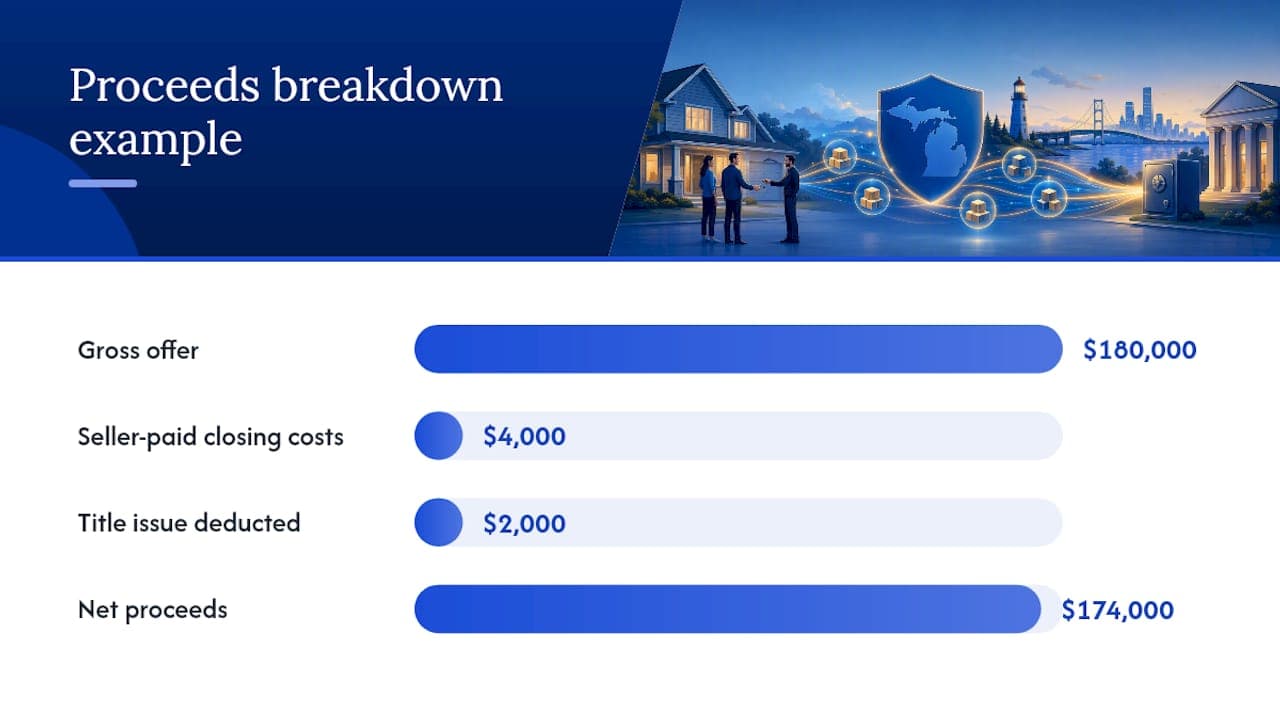
A quick example: a $180,000 offer with $4,000 in seller-paid closing costs and a $2,000 title issue nets $174,000. A competing $175,000 offer with no seller costs and clean title nets the same amount, but closes two weeks faster. Sellers frequently forget to ask who’s covering the transfer tax until the closing statement lands in front of them.
Watch for these red flags: fees that appear only at closing, vague or verbal contingency language, and any structure involving payments over time instead of cash at closing.
Michigan-Specific Legal and Tax Items to Confirm Before Closing
Michigan sellers carry specific state obligations that a title company should walk you through, but you should still know them going in.
- State Real Estate Transfer Tax (SRETT): This is typically the seller’s responsibility. Confirm at the start of negotiations who is filing and paying it, since the Michigan Treasury’s SRETT guidance lays out the rate structure and exemptions.
- Property Transfer Affidavit (Form L-4260): Michigan law requires this filed within 45 days of the transfer of ownership. Miss the window and you risk penalties, so verify with your title company that it’s handled at closing, not left to you afterward.
- Federal capital gains exclusion: IRS Publication 523 allows you to exclude up to $250,000 in gain (single) or $500,000 (married filing jointly) on your primary residence if you meet the ownership and use tests. If your situation is unusual (rental history, inherited property, partial-year residency), talk to a tax advisor before closing.
- Avoid installment or contract-for-deed structures. These spread payments out over time and can leave you legally and financially exposed if the buyer defaults, which is a very different risk profile than cash at closing.
Protecting Yourself From Wire Fraud and Predatory Deal Structures
Speed is the whole point of a cash sale, but it’s also exactly what scammers exploit. Three protections matter more than any other:
- Verify wiring instructions by phone, using a number you look up independently, never one provided in an email. The CFPB’s guidance on closing-process wire fraud recommends confirming the receiving account name matches the title company before you send a dime.
- Never pay anyone upfront to “help” sell your house or relieve your mortgage. The FTC warns that mortgage-relief offers requiring upfront fees are frequently scams.
- Be wary of contract-for-deed arrangements. CFPB research shows these often carry predatory terms and higher failure rates than a straightforward cash-at-closing sale.
Pro Tip: If you suspect a wire was misdirected, call your bank immediately and ask them to attempt a wire recall before contacting anyone else. Minutes matter here.
Report suspected fraud to the FBI’s Internet Crime Complaint Center (IC3), your state’s consumer protection office, or your bank’s fraud department.
Why a Competing-Offer Marketplace Fits Urgent Michigan Sellers
A competing cash-offer marketplace exists because a single lowball offer from one investor isn’t a real negotiation. When several vetted local buyers compete for the same property, sellers under pressure get to see actual numbers side by side instead of guessing whether they’re leaving money on the table.
Whatever route you take, run every offer through the Michigan checklist above before you sign. Disclosures and proof of funds aren’t optional steps.
— Bryan
Get Multiple Cash Offers Through Housegoodbye
Housegoodbye is the alternative to negotiating with a single investor. Instead of one take-it-or-leave-it number, you get competing cash offers from vetted local buyers who bid against each other, which tends to push your price up rather than leaving you stuck with the first lowball figure.

There’s no agent commission, no repair list, and no staging required. Submit your property details, and local investors typically respond with initial bids within a day or two. From there, you compare price, net proceeds, and proposed closing dates, then pick the offer that actually works for your timeline, whether that’s selling your house fast in a week or giving yourself a bit more room. Before signing anything, confirm proof of funds, get a full fee breakdown, and check who’s handling the Michigan transfer tax at closing. If you’re ready to see what buyers in your area will offer, start by requesting your competing cash offers today.
Sources
- Could that mortgage relief offer be a scam? | Consumer Advice
- CFPB takes action to stop contract-for-deed investors from setting borrowers up to fail
- CFPB webinar: avoiding wire fraud in the mortgage closing process
- State Real Estate Transfer Tax (SRETT) FAQ — Michigan Treasury
- Publication 523, Selling Your Home
FAQ
Is Selling to a Cash Buyer in Michigan a Good Idea?
It’s a good idea when speed, an as-is sale, or avoiding repairs and agent fees matters more than maximizing price through a long market listing. Getting multiple competing offers, rather than negotiating with one buyer, generally improves your outcome within that fast-sale route.
How Fast Can I Actually Close on a Cash Offer in Michigan?
Closings can happen in as little as seven days once title is clear and payoff details are confirmed, though 14 to 30 days is common when a lien or complex payoff needs resolving. The timeline depends heavily on how quickly your title company can clear records.
Does Housegoodbye Charge Homeowners a Fee?
Housegoodbye’s competing cash offers service does not have a published price for homeowners; current details are available directly on the site. Always confirm fee structures and proof of funds in writing before accepting any offer, regardless of which platform or investor you use.
What Michigan Taxes Do I Need to Handle When Selling?
Sellers are typically responsible for the State Real Estate Transfer Tax, and a Property Transfer Affidavit must be filed within 45 days of the sale. Confirm with your title company who is handling each filing so nothing falls through after closing.
Do I Owe Capital Gains Tax on My Michigan Home Sale?
Many sellers qualify to exclude up to $250,000 in gain (single filers) or $500,000 (married filing jointly) under IRS Publication 523, provided they meet the ownership and use tests. If your situation involves rental history or an inherited property, a tax advisor should review it before you close.