If you need the fastest route out of a fire-damaged Michigan home, sell as-is to a cash buyer. If you can wait and carry solid coverage, use insurance to repair and rebuild. Either way, do three things now: notify your insurer today, photograph every room and save the fire department’s incident report, and stick to temporary repairs like boarding up windows rather than permanent fixes. There are marketplaces that connect homeowners with local investors who make direct cash offers on houses in any condition, often closing quickly.
TL;DR:
- Selling as-is to a cash buyer usually closes within one to three weeks, which is much faster than repair and rebuild timelines of three to nine months.
- If your insurance payout approaches or exceeds your repair estimate, selling as-is can protect more of your money than investing in repairs.
- Independent estimates often reveal damage costs higher than insurance adjusters initially estimate, which can influence your decision to sell or repair.
- Michigan law requires full disclosure of fire and smoke damage when selling, even if the house is sold as-is, and permits are necessary for any repairs.
- Multiple competing cash offers through specialized platforms typically yield higher net proceeds and quicker closing compared to a single lowball bid or traditional listing.
Table of Contents
- What Are Your Options for a Fire-Damaged House in Michigan?
- How Do Insurance Claims and Payouts Work After a Michigan House Fire?
- Who Should Assess Fire Damage Before You Repair or Sell?
- How Does Selling a Fire-Damaged House As-Is Work in Michigan?
- How Do You Decide Fast Without Getting Burned?
- What Should You Do in the First 24 Hours After a House Fire?
- How Do You Compare Repair, Rebuild, and Sale Routes Financially?
- What Costs Should You Expect for Repair or Sale?
- What Legal Requirements Apply to Selling a Fire-Damaged House in Michigan?
- Why Clear Options Reduce Long-Term Harm
- Get Multiple Cash Offers on Your Fire-Damaged House
- Sources
- FAQ
What Are Your Options for a Fire-Damaged House in Michigan?
Every homeowner with a fire damaged house in Michigan lands in one of four lanes: repair and stay, repair then sell, sell as-is right now, or sell the land alone if the structure is a total loss. Each comes with a different timeline and a different number at closing.
Repair and rebuild usually takes three to nine months depending on permit backlogs and contractor availability, and it only makes sense if your insurance payout covers most of the rebuild cost and you have somewhere to live in the meantime. Repair then sell stretches the timeline further because you are paying for both the rebuild and the eventual listing process, but it can net the highest sale price if the neighborhood supports it. Selling as-is typically closes in one to three weeks with a cash buyer and skips repairs entirely, though the offer reflects the cost of the damage. Selling the land applies when the fire gutted the structure past the point of economical repair. Redfin’s guidance on fire-damaged home sales confirms as-is sales are a common, practical route when repair costs run high or the owner just needs to move fast.
Before you pick a lane, pull together this information:
- Your policy’s dwelling coverage limit and deductible amount
- Your current mortgage balance and remaining equity
- A rough repair estimate from at least one licensed contractor
- How many weeks or months you can realistically wait
If the repair estimate approaches or exceeds your coverage limit, or your mortgage balance leaves little equity after depreciation holdbacks, selling as-is often protects more of your money than pouring cash into a rebuild.
How Do Insurance Claims and Payouts Work After a Michigan House Fire?
Michigan law puts firm deadlines on your insurer once you file a claim. Under the state’s homeowners insurance claims guidance, the company must tell you within 30 days what information it needs to process your claim, and it must pay out within 60 days of receiving your proof of loss. Overdue claims start accruing interest, which gives you leverage if the insurer drags things out.
Michigan Insurance Code, MCL 500.2827, allows insurers to settle fire claims either by paying actual cash value (ACV) or by conditioning full replacement-cost payment on completed repairs. You can often elect a cash settlement based on ACV instead of waiting through a repair process, though policy language and mortgage lender requirements can affect whether you keep those funds if you sell without rebuilding.
That distinction between ACV and replacement cost matters more than most homeowners realize. ACV pays the depreciated value of what burned. Replacement cost pays what it actually costs to rebuild it new, but insurers frequently hold back the depreciation difference until you show proof the repairs happened. Reading the Michigan fire policy statute closely tells you which settlement structure your policy actually uses.
Practical steps to protect your claim:
- Notify your insurer the same day or the next business day after the fire.
- Keep every receipt for temporary repairs, hotel stays, and cleanup, since these get reimbursed separately from the structure claim.
- Avoid signing any permanent repair contract until the adjuster has inspected and approved the scope.
- Log every phone call and email with dates and names.
- If the settlement feels low, request an independent appraisal, file a complaint with the Michigan DIFS, or consult an attorney before accepting.
Who Should Assess Fire Damage Before You Repair or Sell?
Three professionals answer three different questions, and skipping any one of them tends to cost homeowners money later.
A fire-restoration contractor walks the property and produces a line-item repair estimate covering smoke remediation, structural framing, electrical, and drywall. A structural engineer gets involved when the fire compromised load-bearing walls, the roof structure, or the foundation, and their report often determines whether a lender will even finance a buyer’s purchase. An independent inspector or appraiser gives you a value opinion that is not tied to the insurance company’s interests, which is exactly the leverage you need if the adjuster’s number feels short.
Insurance adjusters routinely underestimate total damage because smoke and water intrusion hide inside walls and ductwork long after visible flames are out, according to consumer guidance from the Liss + Earls law firm on fire claim payouts. Homeowners who get a second, independent estimate frequently find the gap between the adjuster’s number and the real cost is significant enough to justify the appraisal fee.
- Fire-restoration contractor: itemized repair cost estimate
- Structural engineer: load-bearing and safety assessment
- Independent inspector/appraiser: unbiased value opinion
- General contractor: second opinion on rebuild timeline and cost
Pro Tip: Get your independent estimate before your adjuster meeting, not after. Walking in with your own numbers changes the conversation from “accept or dispute” to “let’s reconcile two professional opinions.”
How Does Selling a Fire-Damaged House As-Is Work in Michigan?
Selling as-is starts with requesting offers, not with listing the house on the open market and hoping a traditional buyer looks past the damage. Most conventional buyers cannot get financing on a fire-damaged structure anyway, since lenders typically require the home to be habitable at closing.
The process runs in four steps. First, you submit basic property details to a cash-buyer marketplace or individual investor. Second, the investor or a representative does a walk-through, sometimes within 24 to 48 hours of your request. Third, you receive an offer that factors in the repair cost, the teardown value if rebuilding does not make sense, and the underlying land value in your specific Detroit, Farmington Hills, or Sterling Heights neighborhood. Fourth, once you accept, closing typically happens in one to three weeks, sometimes faster.
Some marketplaces gather multiple competing offers from vetted local investors instead of leaving you with just one number to evaluate, and closings can sometimes happen quickly when a homeowner needs to move fast. You can compare cash offers from real Michigan investors rather than negotiating against a single buyer with no competition pushing the price up.
- Speed favors as-is sales; price often favors repair-then-sell if you have the time and cash flow.
- Investors weigh repair cost, teardown/rebuild economics, and comparable land values in your area.
- Michigan sellers must still disclose known material defects even in an as-is sale.
- Multiple competing offers typically beat a single lowball bid from one buyer.
How Do You Decide Fast Without Getting Burned?
Speed matters, but a rushed decision on a fire-damaged property can cost you thousands. Run through this before you sign anything.
- Check urgency first. Do you have somewhere safe to live for the next six to nine months, or do you need cash and closure now?
- Confirm your equity position. Subtract your mortgage balance and any liens from your realistic as-is or repaired value.
- Get two numbers: a contractor’s repair estimate and at least one cash offer, then compare net proceeds side by side.
- Ask your insurer exactly what your policy pays: ACV, replacement cost, or a cash-settlement option under MCL 500.2827.
- Ask any cash buyer for proof of funds, their planned closing date, and whether they require an inspection contingency.
Pro Tip: A legitimate cash buyer never pressures you to skip inspections or sign a release before you have a written offer in hand. If a buyer refuses a walk-through or rushes you past disclosure paperwork, walk away.
Watch for red flags: anyone pushing you to sign a release of claims against your insurer, buyers who will not put proof of funds in writing, unlicensed contractors quoting suspiciously low repair costs, or offers structured to make you waive mandatory Michigan disclosures.
What Should You Do in the First 24 Hours After a House Fire?
Do not re-enter the structure until the fire department or a building inspector confirms it is safe. Smoke-weakened floors, compromised electrical systems, and structural instability cause injuries every year to homeowners who go back in “just to grab a few things.”
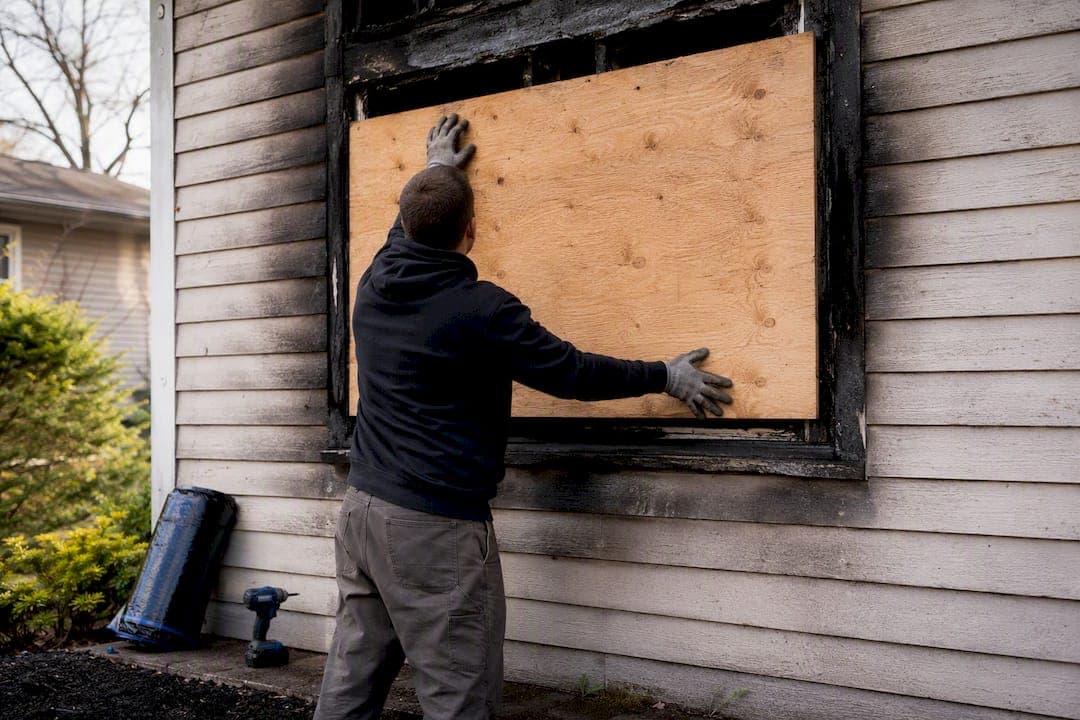
Board up broken windows and exposed openings as soon as it is safe to do so, both to prevent weather damage and to keep the insurance claim clean. Most policies cover this kind of temporary protection, and skipping it can actually give an insurer grounds to argue you failed to mitigate further loss.
Preserve evidence rather than cleaning it up. Photograph every room, every damaged item, and the exterior from multiple angles before anyone touches debris. Request a copy of the official fire department incident report, since your insurer will ask for it and it establishes an independent, third-party account of what happened.
Contact your insurance company the same day if possible. Michigan DIFS disaster guidance recommends notifying your insurer promptly and keeping a running inventory of damaged belongings along with receipts for anything you buy afterward, from clothing to temporary lodging.
If you are uninsured or your coverage falls short, contact the Red Cross at 800-RED CROSS or FEMA at 800-621-FEMA. Both organizations maintain assistance channels specifically for households displaced by fire, and Michigan’s own disaster guidance points homeowners toward them when insurance alone will not cover the gap.
How Do You Compare Repair, Rebuild, and Sale Routes Financially?
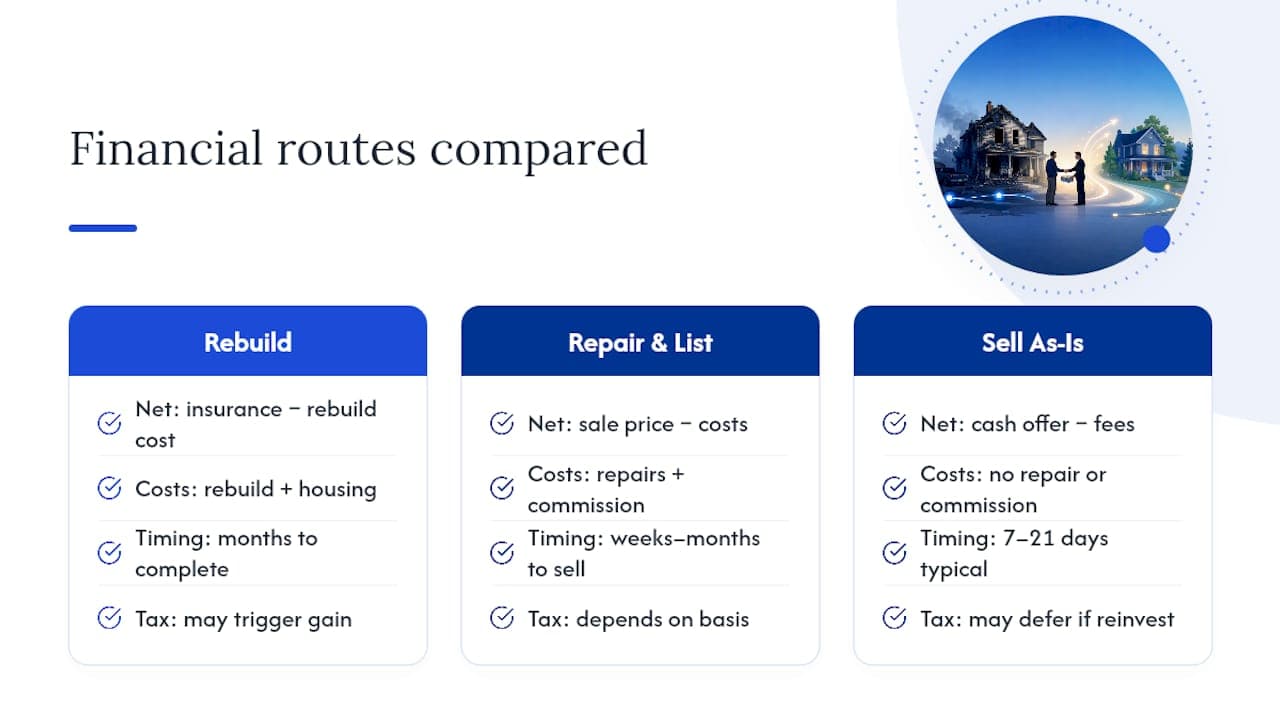
Net proceeds, not the sticker price of an offer or a rebuild estimate, is what should drive your decision. A $180,000 insurance payout minus a $160,000 rebuild cost leaves far less cushion than a $140,000 cash offer on a house with no mortgage left to pay off.
Run the math on each path: subtract your remaining mortgage balance, any liens, and estimated closing costs from whatever number each route produces. For a rebuild, factor in months of alternative housing costs the way you would any other line item. For an as-is sale, remember there are no realtor commissions, no repair costs, and no carrying costs while a listing sits on the market.
Michigan sellers must still comply with the state’s standard property disclosure requirements even when selling a fire-damaged home as-is, and any known structural or safety issue needs to appear on that disclosure form regardless of which route you choose.
One tax wrinkle catches homeowners off guard: if your insurance payout exceeds your adjusted basis in the property, that can trigger a taxable gain unless it qualifies as an involuntary conversion under federal tax rules, which generally lets you defer the gain if you reinvest in a similar property within a set replacement period. That determination depends on your specific numbers and timeline, so a tax professional should review it before you finalize either a rebuild or a sale, especially on a property with substantial equity or a large payout.
Selling as-is in many cases lets you keep your insurance proceeds separately from the sale price, though this depends on your policy’s language about repair-triggered payments and your mortgage lender’s requirements, according to Redfin’s guidance on selling fire-damaged homes. Confirm this with your insurer and lender before assuming you can pocket both.
What Costs Should You Expect for Repair or Sale?
Repair costs on a fire-damaged Michigan house vary enormously depending on how far the damage spread beyond the room of origin. A contained kitchen fire with smoke damage in adjoining rooms costs far less to restore than a fire that compromised roof trusses or spread through wall cavities into a second floor. Structural rebuilds that involve framing, electrical rewiring, drywall, flooring, and smoke remediation across multiple rooms represent the higher end of that range, while single-room smoke and soot cleanup sits at the lower end.
Get at least one licensed contractor’s itemized estimate before you commit to any number, since national averages rarely reflect what your specific structure, square footage, and damage pattern will actually cost in Michigan’s labor and materials market.
Selling costs differ sharply between the repair-then-list route and the as-is cash-sale route. A traditional listing after repairs typically carries a real estate agent commission split between both sides’ agents, plus standard closing costs, title fees, and any repairs a buyer’s inspection turns up later. An as-is cash sale strips most of that out: no agent commission, no staging, no additional repair negotiations after the offer, and closing costs are often absorbed differently depending on the buyer.
The financial comparison usually comes down to one question: does the higher potential sale price after repairs outweigh months of carrying costs, contractor payments, and the risk of cost overruns? For homeowners with tight cash flow or a slim insurance payout, it frequently does not.
What Legal Requirements Apply to Selling a Fire-Damaged House in Michigan?
Michigan law requires sellers to complete a written property disclosure statement for most residential sales, and a fire-damaged property is no exception. That disclosure must reflect known material defects, including fire damage, smoke damage, and any structural issues an inspection or contractor uncovered, even if you plan to sell strictly as-is.
Permits complicate the picture if you attempt any repairs before selling. Structural work, electrical rewiring, and plumbing repairs typically require permits from your local municipality, whether that is Detroit, Dearborn Heights, Madison Heights, or another Michigan community. Skipping permits on partial repairs can create title and disclosure problems for the buyer later, and some cash buyers will factor unpermitted work into their offer or walk away entirely.
If the fire triggered a condemnation notice or a local building department flagged the structure as unsafe, that status needs to be resolved or disclosed before any sale closes. Selling as-is does not exempt you from disclosing a condemnation, a code violation, or an open permit.
Working with a local repair vendor who understands Michigan permitting, such as West Michigan’s One Day Doors & Closets for door and closet replacement work, can help you avoid unpermitted repair headaches if you choose the rebuild path instead of selling outright.
Why Clear Options Reduce Long-Term Harm
Watching a home burn does something to people that insurance paperwork never quite accounts for. The paperwork treats it as a claim number. The homeowner is dealing with displacement, decisions under pressure, and often a mortgage payment that does not pause just because the house is unlivable.
What actually helps in that situation is not more information. It is a short list of real options with honest tradeoffs attached, so a stressed homeowner can pick a lane instead of freezing. That is the entire premise behind pairing insurance-repair guidance with a legitimate as-is sale path.
— Bryan
Get Multiple Cash Offers on Your Fire-Damaged House
There are alternatives to sitting on a damaged property while contractors, adjusters, and buyers move at their own pace. Instead of negotiating with one investor who knows you have limited options, some platforms allow you to submit your property once and let multiple local investors compete for it. That competition may push offers higher than a single cold call from a “we buy houses” sign would.

There are no repairs to schedule, no agent commissions to pay, and no staging or cleanup required before anyone walks through. Some marketplaces are designed for situations involving damaged houses and homeowners who need fast cash offers, with closings possible quickly.
Request your offers, compare them side by side using the questions from the decision checklist above, and see how selling your house for cash actually works before you commit to any single buyer. If you’re ready to see what your property is worth as-is, compare real cash offers on your Michigan home today.
This article is general information, not a substitute for advice from a qualified financial advisor. Consult a qualified financial professional about your own circumstances before acting on anything here.
Sources
- Homeowners Insurance Policies: How to Claim What is Yours (FIS-PUB_0216)
- MCL 500.2827 — Fire policy reimbursement (Michigan Legislature)
- Selling a House with Fire Damage (Redfin)
FAQ
How Long Does an Insurance Claim Take on a Fire-Damaged House in Michigan?
Your insurer must tell you within 30 days what information it needs and must pay your claim within 60 days of receiving your proof of loss, per Michigan’s homeowners claims guidance.
Can I Sell a Fire-Damaged House As-Is in Michigan?
Yes. Selling as-is to a cash buyer is a common, lawful option, and Housegoodbye’s marketplace lets you compare multiple cash offers without making any repairs first.
What’s the Difference Between ACV and Replacement Cost?
ACV pays the depreciated value of the damaged property, while replacement cost pays what it actually costs to rebuild new; Michigan law lets you elect a cash settlement based on ACV under certain conditions.
Do I Have to Disclose Fire Damage When Selling My House?
Yes. Michigan requires a written property disclosure covering known material defects, including fire and smoke damage, even in an as-is sale.
How Fast Can I Close on an As-Is Cash Sale?
Cash sales through a marketplace like Housegoodbye can close in as little as seven days once you accept an offer, compared to several months for a repair-then-list route.