TL;DR:
- Selling a fire-damaged home for cash involves collecting competing offers from vetted local investors and choosing the best one.
- Offers typically range from 30 to 50 percent below market value, depending on damage severity, with closings possible in as little as seven days.
The fastest, most reliable way to get cash for a fire-damaged home is to collect competing as-is cash offers from vetted local buyers, then pick the verified best offer. You skip repairs, contractor bids, and lender appraisals entirely. For Michigan homeowners, Housegoodbye connects you to multiple local investors who bid on your property in its current condition, with closings possible in as little as seven days.
Here is what to expect from a cash offer on a fire-damaged property:
- Offer range: Investors typically buy fire-damaged homes 30–50% below comparable unburned properties depending on severity.
- Closing window: As little as 7 days for clear-title properties; 14–30 days when insurance claims or liens need resolving first.
- No repairs required: Cash buyers purchase as-is. You do not need to remediate smoke, fix structural damage, or stage anything.
- Insurance payout: You may keep your insurance proceeds even when selling as-is, which can offset the discounted sale price.
If you are in Michigan and want to start now, submit your property details at Housegoodbye to receive competing offers with no obligation.
Table of Contents
- How does selling a fire-damaged house to a cash buyer actually work?
- What drives the cash offer on a fire-damaged home?
- How do insurance claims and title issues affect your sale?
- What safety steps should you take right after a fire?
- How do you pick a trustworthy cash buyer?
- How Housegoodbye helps Michigan homeowners sell fire-damaged properties
- Key Takeaways
- When selling as-is for cash makes the most sense
- Get competing cash offers for your fire-damaged Michigan home
- Useful sources
- FAQ
How does selling a fire-damaged house to a cash buyer actually work?
The process is more straightforward than most homeowners expect, especially compared to a traditional listing.
- Submit your property information. Share basic details: address, a description of the damage, and photos if you have them. Sight-unseen offers are common for fire-damaged homes, so professional photos are not required.
- Receive competing cash offers. Vetted local investors review your submission and return offers, typically within 24–48 hours. On a marketplace like Housegoodbye, multiple buyers bid, which creates upward pressure on the offer price.
- Review and select the best offer. Compare net proceeds after fees, closing costs, and any board-up or removal costs the buyer covers. More on how to compare offers is in the buyer checklist section below.
- Handle title and insurance. Your title company or real estate attorney confirms ownership, clears any liens, and documents how insurance claim proceeds will be distributed. This step is where most delays happen.
- Close. Sign the closing documents, transfer title, and receive your funds. For properties with a clear title and a settled insurance claim, closing in 7 days is realistic. When liens or open claims exist, 14–30 days is more typical.
What to prepare before you submit:
Gather date-stamped photos of the damage, your fire department incident report, proof of ownership (deed or recent tax statement), your mortgage payoff amount if applicable, and the current status of any insurance claim. Having these ready can cut days off the closing timeline.

Pro Tip: Give buyers clear access to the property for a walkthrough, even a brief one. A buyer who can confirm the damage scope firsthand will often tighten their offer upward rather than padding in a large unknown-damage buffer.
Selling your house for cash removes lender appraisal delays and the back-and-forth of repair negotiations, which is why it works especially well for owners dealing with displacement, probate, or urgent financial pressure.
What drives the cash offer on a fire-damaged home?
Buyers do not guess. Every cash offer on a burned property runs through a rough formula: after-repair value (ARV) minus estimated rehab costs, minus holding and financing costs, minus the buyer’s profit margin. Your offer is what is left. Understanding the inputs helps you anticipate the number and, in some cases, improve it.
Key valuation factors
Structural vs. cosmetic damage. Investors treat smoke-only damage and structural charring very differently. Soot and smoke odor require specialized cleaning, thermal fogging, and duct replacement, but the building’s bones are intact. Charred beams, joists, or trusses require structural engineering and full replacement, which can double or triple the rehab budget.
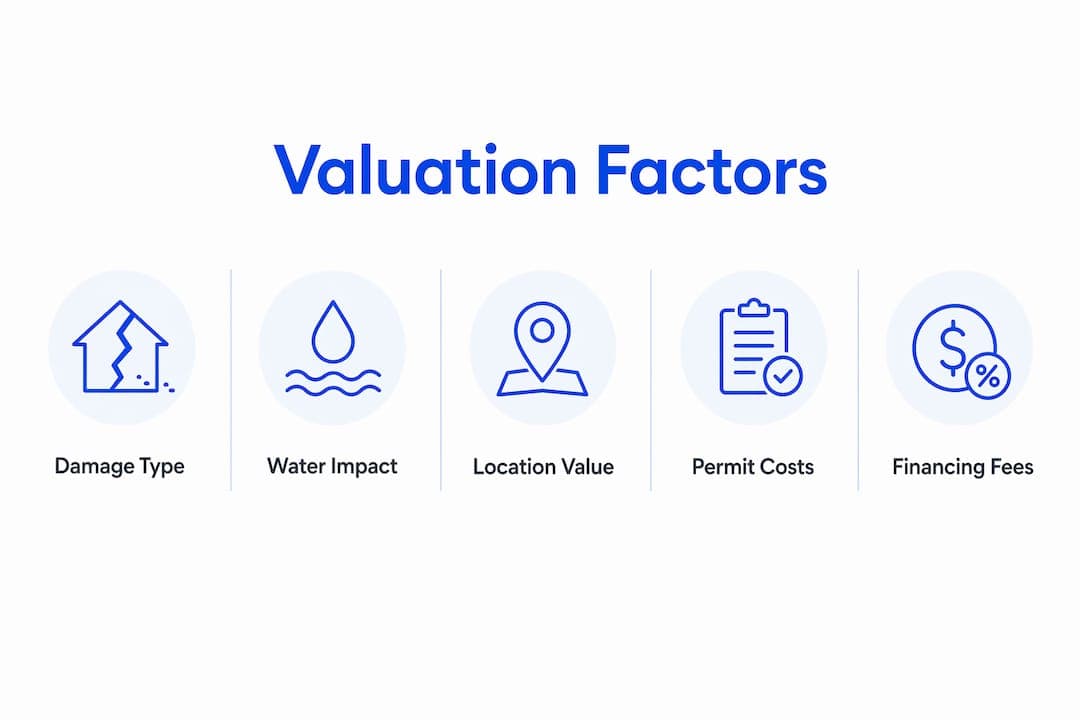
Water damage from firefighting. Water used to suppress the fire often creates hidden mold and structural issues that are not visible on a walkthrough. Buyers build in a contingency for this, which lowers offers on properties where water intrusion is likely.
Lot and location value. In high-demand markets, the land itself carries significant value. A buyer may offer more on a burned home in a desirable neighborhood because the ARV after rebuild is strong, even if the structure is a total loss.
Permitting and code upgrades. Rebuilding after a fire often triggers current building code requirements, which can add cost beyond simply restoring what existed. Buyers factor this in.
Buyer financing costs. Most investors use cash or hard-money loans that carry interest in the 10–14% range. Those carrying costs get built into the acquisition price, which is part of why fire-damaged home offers run below market.
| Damage category | Typical offer range vs. pre-fire value | Primary cost driver |
|---|---|---|
| Cosmetic/smoke only | 30–50% below | Remediation, cleaning, HVAC |
| Partial structural | 30–50% below | Framing, engineering, code upgrades |
| Major/total loss | 30–50% below | Full rebuild, permits, land value only |
Pro Tip: A single contractor estimate or structural engineer’s note narrows the buyer’s unknowns. A reliable investor will often move from a wide, conservative offer to a tighter, higher bid once the scope is verified.
How do insurance claims and title issues affect your sale?
These two factors cause most of the friction in fire-damaged home sales. Getting ahead of both early saves time and money.
Insurance claim scenarios
- Claim already settled, payout received. The cleanest scenario. You keep the insurance proceeds and sell the damaged property separately. Sellers can often keep insurance proceeds even when selling as-is, and combining the payout with the sale price can approximate pre-fire net proceeds in some cases.
- Open claim, not yet settled. You can still sell. An active insurance claim does not legally block a property transfer, but you need to decide whether to settle before closing or assign the claim to the buyer.
- Claim assignment to the buyer. The claim can be transferred as a financial asset with the buyer’s agreement. The buyer gains a funding source for renovation; you typically receive a higher sale price in exchange. The assignment must be explicitly documented in the purchase contract, and some policies contain anti-assignment language, so review your policy first.
- Settling before closing. Settling an insurance claim before closing usually creates a cleaner transaction and avoids complex title-related distribution of proceeds at closing. The tradeoff is time.
Title complications
Unpaid contractor liens, outstanding mortgages, and tax liens all attach to the title and must be resolved before or at closing. Get a payoff letter for your mortgage and request a preliminary title report early. A title officer can surface hidden liens that would otherwise delay closing by weeks.
Pro Tip: A short consult with a title officer or real estate attorney before you accept any offer often saves more time than it costs. If a public adjuster is involved, engage them before you sign anything, since a public adjuster can uncover overlooked coverages that increase your payout.
State-specific disclosure rules vary. Some states require written disclosure of fire damage history even in as-is sales. Confirm your state’s requirements with a local real estate attorney before closing.
What safety steps should you take right after a fire?
Securing the property protects you from liability and preserves the value buyers will see.
Immediate actions:
- Board up all windows, doors, and open roof sections to prevent trespass and weather damage.
- Shut off gas and electricity at the meter if the utility company has not already done so.
- Post hazard signage at entry points if the structure is unsafe to enter.
- Lock gates and perimeter access points.
Documentation to collect:
- Date-stamped photos of all damage, taken before any cleanup or board-up work begins.
- The fire department incident report (request a copy from your local fire marshal’s office).
- Receipts for all emergency board-up or temporary repair work.
- An itemized inventory of damaged personal property for your insurance claim.
Buyers respond better to properties with documented, professional mitigation. Evidence of board-up and a fire report signals that the damage is known and contained, which reduces the unknown-risk buffer buyers build into their offers.
Pro Tip: Photograph everything before you touch it. Once remediation starts, the original damage evidence is gone. Your insurance adjuster and any buyer’s inspector will both want to see the pre-mitigation condition.
How do you pick a trustworthy cash buyer?
Not every buyer offering cash for a fire-damaged property is equally reliable. Here is a practical checklist.
Questions to ask every buyer:
- Can you provide written proof of funds today?
- How many fire-damaged properties have you purchased in the past 12 months?
- What is your realistic closing timeline, and what could delay it?
- Who handles permits, board-up costs, and debris removal?
- How do you handle open insurance claims, and will you accept a claim assignment?
Documents to demand before signing:
- Written proof of funds (bank statement or lender commitment letter, dated within 30 days).
- A clear purchase agreement with the closing date, earnest money terms, and any contingencies spelled out.
- A title/escrow plan naming the title company.
- An estimated closing statement showing your net proceeds after all fees and liens.
- Explicit assignment paperwork if the buyer is taking over your insurance claim.
Red flags to walk away from:
- Refuses to provide proof of funds or delays it repeatedly.
- Asks for a large nonrefundable deposit before signing a purchase agreement.
- Pressures you to sign quickly without giving you time to review documents.
- Proposes off-title arrangements or unusual payment structures.
- Cannot name the title company they plan to use.
When comparing multiple cash offers, normalize by net proceeds after all fees and liens, not the headline offer number. A higher offer that requires you to pay board-up costs and closing fees can net less than a lower offer where the buyer covers those items. Use as-is price negotiation tips to strengthen your position before you accept.
How Housegoodbye helps Michigan homeowners sell fire-damaged properties
Housegoodbye is a marketplace that connects Michigan homeowners to multiple vetted local cash buyers, generating competing as-is offers without repairs, staging, or agent commissions. The bidding process creates upward pressure on offers that a single-buyer approach does not.
How it works:
- Submit your property details. Share your address, damage description, and any photos or documents you have (fire report, insurance status, title info). The more you provide upfront, the faster competing offers come in.
- Receive competing cash offers. Vetted local investors review your submission and submit bids. You see multiple offers side by side, which lets you compare net proceeds and closing timelines directly.
- Choose your best offer and close. Pick the verified offer that fits your timeline and financial needs. Housegoodbye supports closings in as little as seven days for Michigan properties with clear titles.
Housegoodbye’s primary focus is Michigan. If you are outside Michigan, the platform may be able to refer you to local vetted buyers in your area. For Michigan sellers in cities like Holland, Warren, or St. Joseph, local investor networks are active and familiar with fire-damaged property transactions.
The as-is sale process explained through Housegoodbye means no cleaning, no contractor coordination, and no lender appraisal delays standing between you and a closed sale.
Key Takeaways
Selling a fire-damaged home for cash is the fastest, most certain route when speed and reduced complexity matter more than maximizing top-dollar proceeds.
| Point | Details |
|---|---|
| Cash offers run below market | Expect 30–50% below pre-fire value; combining insurance proceeds with the sale price can offset the gap. |
| Timeline depends on title clarity | Clear title and a settled insurance claim can close in 7 days; liens or open claims add 1–3 weeks. |
| Damage type drives the discount | Smoke-only damage draws smaller discounts than structural charring, which requires engineering and full framing replacement. |
| Vet every buyer before signing | Demand written proof of funds, a clear purchase agreement, and a named title company before accepting any offer. |
| Housegoodbye for Michigan sellers | Submit property details to Housegoodbye to receive competing as-is cash offers from vetted local investors with no obligation. |
When selling as-is for cash makes the most sense
The conventional advice is to restore and list for maximum value. That logic holds in one specific scenario: you have the funds to rebuild, a contractor lined up, tolerance for a 6–12 month process, and an ARV that meaningfully exceeds the as-is sale price plus repair costs. Outside that scenario, it starts to fall apart.
Displacement costs accumulate fast. Temporary housing, storage, and the carrying costs on a property you cannot live in add up month after month while a restoration drags on. Add insurance dispute fatigue, the real possibility of cost overruns on a fire job, and the emotional weight of managing contractors through a traumatic event, and the “just restore it” path looks less appealing than the spreadsheet suggests.
The as-is sale benefits are real: speed, certainty, and a defined outcome. You know what you are getting and when. A cash sale trades top-dollar potential for the ability to move on. For most homeowners after a serious fire, that trade is not a compromise. It is the right call.
The one case where restoring genuinely makes sense is when the lot value alone is modest, the damage is cosmetic, and you have the financial cushion to wait. If any of those three conditions is missing, the as-is cash route almost always wins on a risk-adjusted basis.
Get competing cash offers for your fire-damaged Michigan home
If you need to sell a fire-damaged property without repairs, staging, or agent fees, Housegoodbye gives you a direct path to multiple verified cash offers from local Michigan investors. You submit once, investors compete, and you choose the offer that fits your timeline.

No obligation. No commissions. Closings available in as little as seven days for eligible properties. Michigan homeowners can compare real cash offers right now by submitting their property details. If you want to understand the full process before you start, the how cash sales work page walks through every step.
Useful sources
| Resource | What it covers |
|---|---|
| FEMA Disaster Assistance | Federal disaster aid, temporary housing, and recovery programs after a fire |
| National Fire Protection Association (NFPA) | Fire safety standards, post-fire safety guidance, and structural assessment resources |
| Your state insurance department | File complaints, verify adjuster licenses, and understand your state’s claim rules |
| American Land Title Association (ALTA) | Title insurance standards, finding a title officer, and understanding closing documents |
| HUD Housing Counseling | Free housing counseling for homeowners facing financial hardship after a disaster |
| Housegoodbye fire-damage page | Michigan homeowners: submit property details and receive competing as-is cash offers |
For insurance claim disputes, a licensed public adjuster (find one through the National Association of Public Insurance Adjusters at napia.com) can review your claim and negotiate on your behalf. For title and closing questions, consult a licensed title officer or a real estate attorney in your state.
This article is general information, not legal, financial, or insurance advice. Confirm current rules and your specific situation with a qualified professional before making decisions.
FAQ
How much can you expect from a cash offer on a fire-damaged home?
Cash buyers typically offer 30–50% below the pre-fire market value, depending on damage severity. Combining that sale price with your insurance payout can approximate your pre-fire net proceeds in some cases.
How do buyers price a fire-damaged house?
Buyers calculate ARV minus estimated repair costs, holding costs, and their profit margin. Structural charring, water damage from firefighting, and code-upgrade requirements all increase the repair estimate and push the offer lower.
Is buying a fire-damaged house risky?
For investors, the risks are manageable with proper due diligence, but conventional lenders typically decline fire-damaged properties, which is why most buyers use cash or hard-money financing. For a homeowner buying to occupy, hidden structural and mold issues make a thorough inspection and contractor scope critical before purchase.
Can you get a mortgage on a fire-damaged property?
Standard mortgages are rarely available for severely fire-damaged homes because the property does not meet habitability standards required by conventional lenders. Buyers rely on cash or private bridge loans that underwrite based on the rehab plan and after-repair value rather than current condition.