
Most Michigan divorces end with the marital home either sold and the proceeds split, bought out by one spouse, or awarded to one party under the judgment of divorce. Courts do not default to a straight 50/50 split. Your first move should be ordering a home valuation and talking to your family-law attorney and a CPA before you decide on timing or sale method.
TL;DR:
- Selling the home and dividing proceeds is the most common option when neither spouse can afford to keep the property alone.
- Courts weigh factors like marriage duration, contributions, and custody arrangements to fairly assign ownership rather than splitting equally.
- Appreciation during marriage on a premarital home can be considered marital property, requiring valuation at both start and end of marriage.
- Timing the sale before or after divorce affects tax exclusions, with selling while still married allowing up to a $500,000 gain exclusion for joint filers.
- Quick cash sales with vetted investors can be practical when speed outweighs maximizing sale price or extensive repairs are undesirable.
Table of Contents
- The three basic options for the marital home
- How Michigan courts decide who keeps the house
- Marital vs separate property: premarital equity and appreciation
- Tax rules and timing that change how much you net
- Practical checklist for selling during a divorce
- Deeds, refinancing, and lender obligations
- Timelines and costs to expect
- Drafting settlement language that prevents future disputes
- When a fast, as-is sale makes sense during divorce
- Getting multiple cash offers without the usual selling hassle
- Sources
- FAQ
The three basic options for the marital home
Every Michigan couple facing this decision ends up choosing among three paths, and the right one usually comes down to affordability rather than preference.
Selling and dividing the net proceeds is the most common route when neither spouse can carry the mortgage, taxes, and upkeep alone. It also tends to be the cleanest way to close out the marital estate because there’s no lingering-shared asset to manage after the judgment of divorce is entered.
A buyout lets one spouse keep the house by paying the other their share of the equity. Buyout payments are often structured as a lump sum at closing, a promissory note paid over time, or an offset against other marital assets like retirement accounts. Attorneys frequently recommend escrowing the buyout funds until the deed and refinance are both complete, so neither spouse is left exposed if something falls through.
Award or continued co-ownership happens less often, usually when a judge wants to preserve stability for children and delays the sale until a set future date, such as when the youngest child graduates from high school.
- Sell and split: fastest way to fully separate finances, but requires agreement on timing and price.
- Buyout: keeps one spouse in the home, but requires cash or refinancing capacity.
- Award or co-own: protects children’s routine, but extends financial entanglement between ex-spouses.
How Michigan courts decide who keeps the house
Michigan is an equitable distribution state, which means judges divide marital property fairly, not necessarily equally. This comes from Michigan Compiled Laws MCL 552.401, which along with MCL 552.19 sets out the statutory basis for dividing property in a divorce judgment.
To apply that standard, Michigan courts weigh what are commonly called the Sparks factors:
- Duration of the marriage: longer marriages tend to see more commingling of separate and marital property.
- Contributions to the marital estate: includes income, homemaking, and financial or labor investment in the property itself.
- Age and health of each party: can affect earning capacity and housing needs going forward.
- Life status and earning ability: a spouse with limited job prospects may receive a larger share of home equity.
- Necessities and circumstances of each party: including which spouse has primary custody of children.
- General principles of equity: a catchall that lets judges account for fault or unusual circumstances.
When one spouse is the sole custodial parent with limited income, courts often lean toward awarding the home or a larger equity share to that spouse. When neither party can realistically afford the mortgage, taxes, and insurance alone, a court-ordered sale becomes the practical outcome, and Michigan Legal Help confirms that judges can order a sale when spouses can’t agree on what to do with the house.
Marital vs separate property: premarital equity and appreciation
Separate property generally includes anything owned before the marriage or received individually as a gift or inheritance. Marital property includes everything acquired during the marriage, plus any appreciation that occurred while you were married, even on a home one spouse bought beforehand. Michigan appellate decisions have addressed this distinction directly: premarital down payments and appreciation that happened before the wedding can remain separate, but appreciation during the marriage is often treated as marital property subject to division. In at least one Michigan Court of Appeals opinion, the court corrected a trial court’s misclassification of marital home appreciation, underscoring how much this distinction matters in practice.
Valuing that split usually means getting an appraisal for the home’s value both at marriage and at the point of divorce, then subtracting the premarital equity to isolate the appreciation that counts as marital property.
To protect a separate-property claim, gather:
- The original deed and purchase closing statement.
- Bank records showing the down payment source.
- Invoices for major improvements made during the marriage.
- Any gift letters or inheritance documentation tied to the property.
Pro Tip: Keep these documents in one folder from the start of your case; reconstructing a paper trail after months of separation is far harder than saving it upfront.
Tax rules and timing that change how much you net
Selling the marital home triggers Section 121 of the tax code, and the timing of your sale relative to your divorce can cost or save you tens of thousands of dollars.
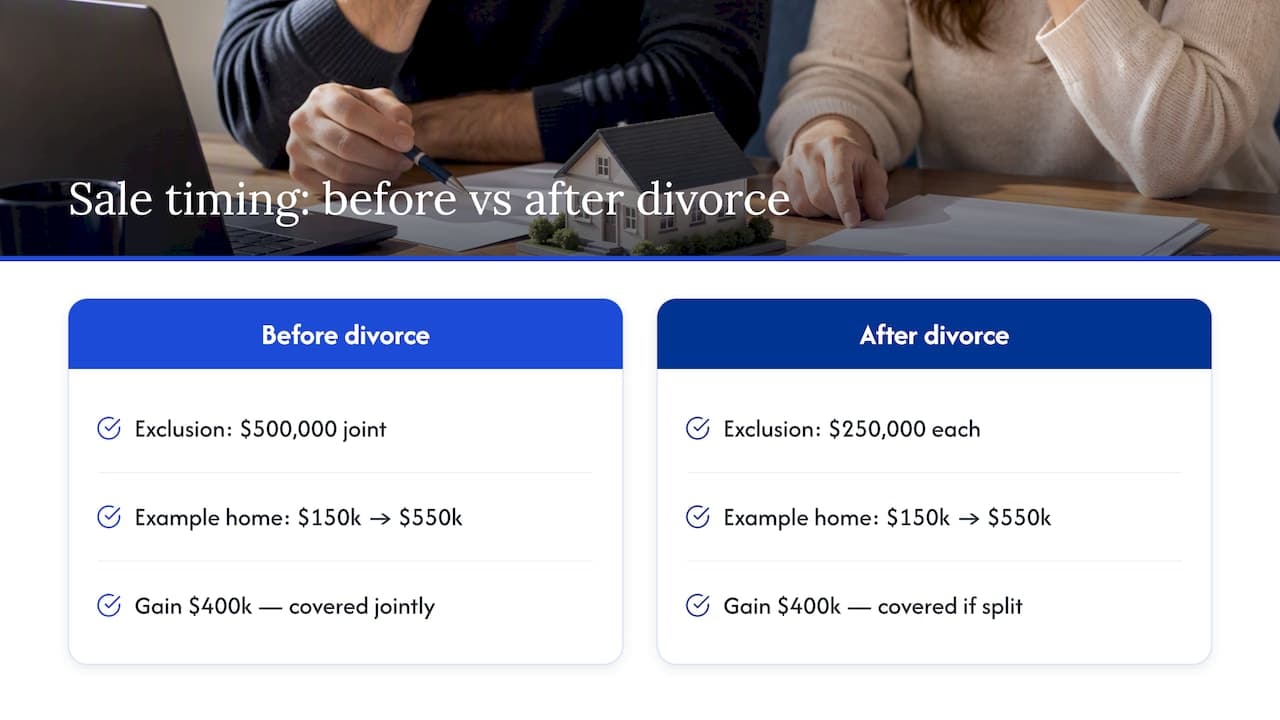
Married couples filing jointly can exclude up to $500,000 of gain on a home sale, while single filers can exclude up to $250,000, according to IRS Publication 523. That gap is the single biggest reason timing matters.
Three scenarios illustrate the stakes. If you sell while still legally married and both spouses meet the ownership and use tests, you can claim the full $500,000 exclusion together. If you finalize the divorce first and then sell, each ex-spouse is generally limited to a $250,000 exclusion apiece, which only matters if your combined gain exceeds that per-person threshold. Say a home bought for $150,000 sells for $550,000: the $400,000 gain fits under the joint exclusion if sold before the divorce is final, but after finalization each spouse’s separate $250,000 cap still covers it as long as the gain is split evenly. Practical guidance from Mitten Law notes that selling while still married preserves the full joint exclusion, while waiting until after the divorce is finalized usually limits each spouse to the smaller individual exclusion, a difference that can matter significantly in higher-appreciation markets.
Divorce settlements can also attribute one spouse’s ownership and use to the other for IRS purposes when one spouse moves out before the sale, a nuance worth writing into your judgment of divorce with your attorney’s help, per IRS guidance. You can read more on how sale timing affects the exclusion in a dedicated breakdown.
Practical checklist for selling during a divorce
Once you’ve decided to sell, the process runs smoother when you follow a set order rather than juggling everything at once.
- Order an appraisal or comparative market analysis to establish a defensible current value.
- Gather your title, mortgage statement, and prior closing documents so your attorney and any buyer can move quickly.
- Decide between listing with an agent or accepting an as-is cash offer, based on how much time and cash you have for repairs.
- Compare net proceeds under each method, factoring in commissions, prep costs, and holding costs like mortgage payments during a longer listing.
- If the home is underwater, contact the lender about a short sale and get any deficiency allocation written into your settlement.
Listing with an agent typically nets a higher sale price but comes with commissions, repair costs, and a longer timeline, often two to three months before closing. As-is cash offers close faster and skip repair costs entirely, which matters when neither spouse wants to keep funding a house that’s no longer serving either of them. You can compare listing versus as-is cash offers directly against your specific numbers before deciding.
Pro Tip: If you’re already behind on the mortgage, talk to the lender about a short sale before listing, since waiting until foreclosure proceedings start narrows your options considerably.
Deeds, refinancing, and lender obligations
A deed and a mortgage note are two different legal instruments, and confusing them causes real problems after divorce. A quitclaim deed transfers ownership of the property, but it does not remove either spouse from the mortgage note. According to Best Lawyers, refinancing is generally the only reliable way to release a departing spouse from loan liability.
That means the spouse keeping the house typically needs to qualify for a new loan on their own income and credit, which lenders will evaluate along with a fresh appraisal. Until that refinance closes, the spouse who moved out remains legally responsible for the mortgage even if their name comes off the deed.
- Quitclaim deeds transfer title but leave mortgage liability untouched.
- Refinancing under one spouse’s name and credit is usually required to fully sever loan responsibility.
- Recording the deed with the county Register of Deeds is required to make the transfer official, and Michigan Legal Help confirms this step along with typical transfer-tax exemptions when the deed references the Judgment of Divorce.
Timelines and costs to expect
Realistic planning means knowing roughly how long each phase takes and who typically covers which cost.
An appraisal usually takes one to two weeks to schedule and complete. A traditional agent-assisted listing often runs six to ten weeks from listing to accepted offer, plus another thirty to forty-five days to close. As-is cash offers can compress that timeline to as little as seven to fourteen days from offer to closing, since there’s no financing contingency or repair negotiation to slow things down.
- Mortgage payments, property taxes, and insurance up to closing are usually allocated in the settlement, often split proportionally or assigned to whoever remains in the home.
- Real estate commissions, typically the largest single cost in a traditional sale, along with title fees and transfer taxes, come out of the sale proceeds before the split.
- Repair costs before listing can add weeks to the timeline and often become a point of dispute over who pays.
If one spouse refuses to cooperate with a court-ordered sale, the other can file a motion to enforce, and Michigan Legal Help notes that courts can appoint a receiver or hold a noncompliant spouse in contempt to move the sale forward. You can read more about what happens when a spouse won’t cooperate with a court-ordered sale.
Drafting settlement language that prevents future disputes
The judgment of divorce should spell out exactly what happens to the house, not leave it to later interpretation.
- Set a firm sale deadline (for example, within 90 days of judgment) and specify who pays the mortgage, taxes, and insurance until closing.
- Require the deed to reference the Judgment of Divorce when recording, which is generally what qualifies the transfer for Michigan’s transfer-tax exemption.
- Include ownership and use attribution language for IRS purposes if one spouse moves out before the sale, so the exclusion isn’t jeopardized.
- Specify escrow terms for any buyout payment, including what happens if refinancing falls through.
- Name enforcement remedies, such as attorney fees, contempt, or a court-appointed receiver, if one spouse stalls the sale.
When a fast, as-is sale makes sense during divorce
Some Michigan divorces come with a ticking clock: a job relocation, a mortgage neither spouse can keep covering, or a strong mutual desire to finalize the settlement without months of showings and repair negotiations. In those situations, speed and certainty often matter more than squeezing out the last few thousand dollars a traditional listing might bring.
There are services that connect Michigan homeowners with multiple competing cash offers from vetted local investors, buying homes as-is with closings possible in a short timeframe. It’s a practical option worth discussing with your attorney and CPA, not a replacement for their advice on timing, tax attribution, or settlement terms.
— Bryan
Getting multiple cash offers without the usual selling hassle
Selling a house during divorce usually means picking between two bad tradeoffs: a faster sale at a lower price, or a higher price that takes months and requires repairs neither spouse wants to pay for. HouseGoodbye’s competing cash offers process lets you compare real bids from vetted local investors side by side, so you’re not stuck accepting the first lowball number that comes in.

- No repairs or staging required, since offers are made on the home’s as-is condition.
- No agent commissions, which keeps more of the sale proceeds available to split.
- Closings possible in as little as seven days, useful when a settlement deadline is approaching or one spouse can no longer cover the mortgage.
This route fits best when speed matters more than maximizing every dollar, when neither spouse has the cash or credit to handle repairs, or when both parties simply want to stop co-owning the house. Talk to your attorney and CPA about how a sale timeline affects your settlement and tax exclusion before accepting any offer, then request offers through Sell Your House Fast or Sell Your House As-Is to see what your home could bring.
This article is general information, not a substitute for advice from a qualified lawyer. Consult a qualified legal professional about your own circumstances before acting on anything here.
Sources
- Michigan Compiled Laws - MCL 552.401 (Property division statutes)
- Real estate and divorce | Michigan Legal Help
- Publication 523, Selling Your Home | Internal Revenue Service
- Selling The House In A Michigan Divorce - Mitten Law
- Court of Appeals opinion on marital-home appreciation (example case)
FAQ
How hard is it to sell a house during a divorce?
Selling during a divorce adds legal and emotional complexity, but it’s a routine part of many Michigan cases and courts have established processes for it. The biggest hurdles are usually agreeing on timing and price, not the mechanics of the sale itself, and an as-is cash offer can remove the repair and showing burden entirely.
Can my wife take my house if I bought it before marriage in Michigan?
A home you owned before marriage generally stays your separate property, but any appreciation in value during the marriage can be treated as marital property subject to division. Michigan courts have specifically distinguished premarital equity from marital appreciation in appellate rulings, so keeping documentation of your original purchase and down payment matters.
How to avoid financial ruin in divorce?
Get a clear valuation of the marital home and other major assets early, and consult a family-law attorney and CPA before agreeing to any sale timing or buyout structure. Selling while still legally married can preserve the full $500,000 joint tax exclusion under IRS rules, which is one of the more overlooked ways divorcing couples lose money unnecessarily.
What assets are untouchable during a divorce?
Separate property, such as assets owned before the marriage or received individually as a gift or inheritance, is generally protected from division under Michigan law, though commingling those funds with marital assets can complicate the claim. Courts still weigh the Sparks factors and general equity principles, so no asset is guaranteed to stay entirely out of the settlement discussion.