
You can sell a house with liens in Detroit or Farmington Hills, and most sellers still close in a matter of weeks, not months. The lien has to be paid, settled, or discharged before or at closing so the title company can transfer clear title, with most payoffs coming directly from sale proceeds. The fastest reliable route is a cash-offer sale, where an investor buys as-is and the payoff comes straight out of proceeds; a traditional listing works too, but only if the buyer’s lender and your title company can coordinate the payoff before the funds change hands.
TL;DR:
- Selling with a cash offer is the fastest option, often closing within a week, especially if payoff figures are readily available from lienholders.
- Traditional listings may take 30 to 60 days or longer, depending on buyer financing approval, appraisals, and multiple payoff processes.
- If your home’s equity is minimal or negative after liens, a short sale or direct negotiation with lienholders will likely extend the timeline to between 60 and 120 days.
- Michigan law limits judgment creditor recoveries to the owner’s equity after liens and costs, and judgment liens cannot force foreclosure, often leaving clouds on cleared titles.
- Early payoff statement collection and coordination with your title company improve closing speed and reduce last-minute surprises in lien and tax lien management.
Table of Contents
- Can You Sell a House With Liens in Detroit? Your Options
- What Does Michigan Law Say About Judgment Liens and Sale Proceeds?
- What Happens at Closing When Liens Are on the Title?
- What Will You Actually Net After Liens Are Paid?
- How HouseGoodbye Helps Sellers With Liens in Detroit
- Speed vs. Proceeds: Picking the Right Path for Your Situation
- Ready to Compare Cash Offers on Your Liened Property?
- Sources
- FAQ
Can You Sell a House With Liens in Detroit? Your Options
You have real choices here, and which one fits depends mostly on how much equity is sitting in the house versus how fast you need cash in hand.
- Cash sale through an investor or marketplace. This is the quickest path, often within a short time frame from offer to closing. You sell as-is, no repairs, no staging. If your equity is thin after the lien payoff, this may be the only route a traditional buyer’s financing would allow anyway, since most mortgage lenders won’t fund a purchase where title can’t be cleared quickly.
- Traditional listing with payoff at closing. This can net you more if there’s meaningful equity above what you owe lienholders, but it depends on your buyer’s lender, an appraisal that clears, and a title company willing to process multiple payoffs. Expect 30 to 60 days or longer.
- Short sale. If your mortgage balance exceeds the home’s value, a short sale requires your lender’s written approval on a reduced payoff. It’s slower, often 60 to 120 days, and the lender controls the timeline, not you.
- Negotiated settlement or deed-in-lieu. When a lienholder disputes the payoff amount, or you’re trying to avoid foreclosure altogether, direct negotiation (often with an attorney) or a deed-in-lieu arrangement with your mortgage servicer can resolve things without a traditional sale.
- Bankruptcy as a legal backstop. In cases where liens and debt exceed what any sale can cover, bankruptcy may reorganize or discharge certain obligations. This is a decision for a bankruptcy attorney, not a real estate agent, and it’s worth a consult before you rule it out.
Madison Heights, Sterling Heights, and Dearborn Heights sellers face the same menu of options. What changes is local market speed and how quickly a given title company can turn payoff requests around.
What Does Michigan Law Say About Judgment Liens and Sale Proceeds?
Michigan’s Judgment Lien Act, specifically MCL 600.2807, caps what a judgment creditor can collect from a sale. That cap is your equity after senior liens, property taxes, and closing costs are subtracted, not the full face value of the judgment.
A judgment creditor’s recovery from sale proceeds is limited to the judgment debtor’s equity after senior liens and costs are paid. If proceeds fall short, a partial payment satisfies the lien only in part, and the remainder stays attached to the property until it’s fully discharged or a partial discharge is recorded.
Here’s the part most sellers don’t expect: the Michigan Judgment Lien Act gives judgment creditors no foreclosure remedy. A 2010 Michigan Court of Appeals opinion, Thomas v. Dutkavich, confirmed that a purchaser generally has no legal duty under the MJLA to direct sale proceeds toward paying off a judgment creditor. That sounds like good news for buyers, but it means a recorded lien can survive a sloppy closing and keep clouding your title long after you’ve moved out.
One more wrinkle worth checking before you assume the worst: if you own the home as tenants by the entirety with a spouse, a judgment lien only attaches if the judgment was entered against both of you, not just one.
Your practical next steps are straightforward. Pull payoff statements from every recorded lienholder as early as possible, check with the Wayne or Oakland County register of deeds for anything you might not know about, and loop in your title company the moment you decide to sell, not the week before closing.

What Happens at Closing When Liens Are on the Title?
Closing on a liened property follows a predictable sequence, and knowing the order helps you avoid last-minute scrambles.
- Request payoff letters early. Contact each lienholder (mortgage servicer, contractor, judgment creditor, tax authority) and ask for a written, dated payoff statement. Most are only valid for 10 to 30 days, so timing matters.
- Title company builds the settlement statement. Funds get disbursed in priority order: senior mortgage first, then property taxes, then recorded liens by priority date, then your net proceeds.
- Partial payments trigger partial discharges. If proceeds don’t fully cover a lien, the creditor can record a partial discharge for the amount paid, but the unpaid balance stays attached to the property.
- Escrow holds disputed amounts if needed. If a payoff figure is contested, the title company can escrow the disputed portion until it’s resolved, letting the rest of the closing proceed.
The most common delays are missing or expired payoff figures, unresponsive lienholders, and surprise tax liens that show up in a late title search. A 40-year title search ordered early catches most of these before they become closing-day emergencies.
Pro Tip: Call your title company before you list, not after you get an offer. Ask them what payoff documentation they’ll need for each lien type on your property, so you’re not chasing paperwork the week you’re supposed to close.
What Will You Actually Net After Liens Are Paid?
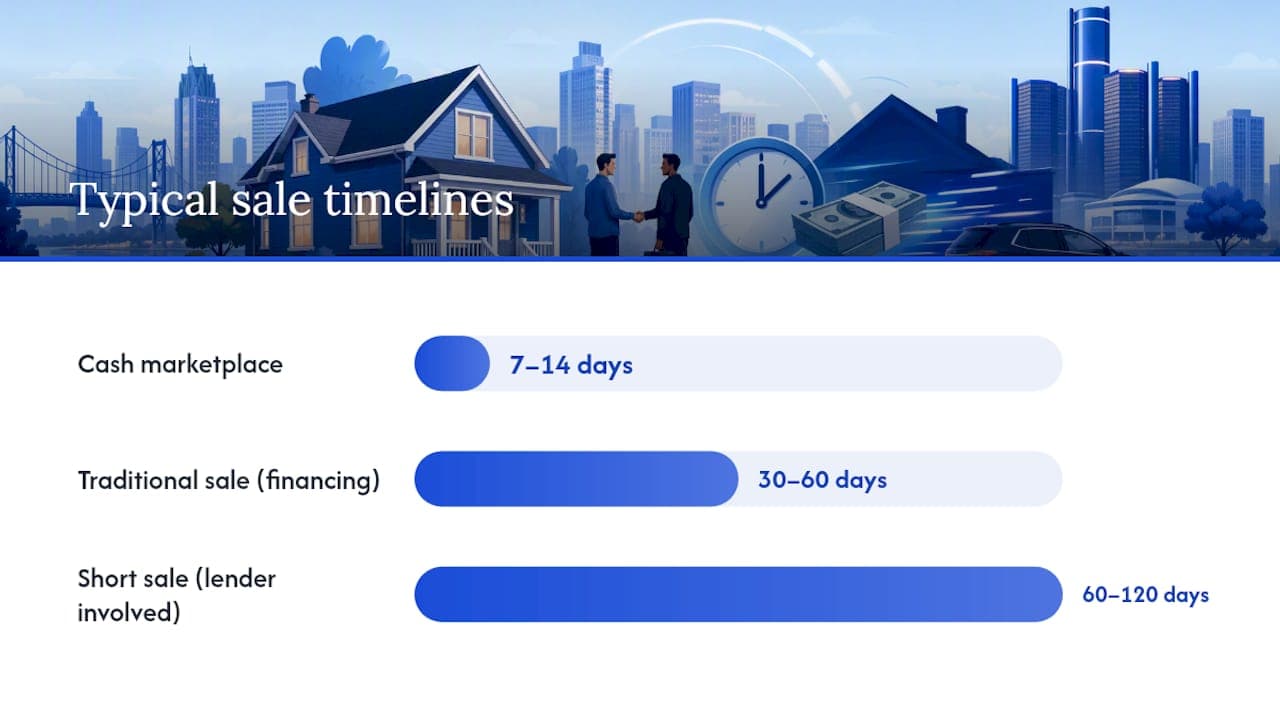
Timelines vary a lot by path: a cash marketplace sale typically runs 7 to 14 days, a traditional sale with financing runs 30 to 60 days or more, and a short sale can stretch to 60 to 120 days once a lender gets involved.
Your net proceeds shrink faster than you’d think once every obligation gets subtracted:
- Remaining mortgage balance
- Recorded judgment liens and mechanic’s liens
- Delinquent property taxes (Wayne and Oakland County tax liens carry their own priority rules)
- Title insurance and escrow fees
- Prorated taxes and recording fees
If your equity comfortably covers every lien plus selling costs, a traditional listing might net more. If equity is tight or negative, a partial discharge scenario means the property stays encumbered even after a sale, which scares off most conventional buyers and their lenders. A quick equity check, current market value minus every payoff figure, tells you almost immediately whether a cash offer is the realistic option or just the fast one.
How HouseGoodbye Helps Sellers With Liens in Detroit
Housegoodbye runs a competitive marketplace where vetted local investors bid on your property, and you compare real cash offers side by side instead of negotiating blind with a single buyer. Because these are cash purchases, there’s no lender underwriting delay, which is usually what kills a liened-property closing in a traditional sale.
- Sell as-is: no repairs, no staging, no agent commissions to layer onto an already tight equity position.
- Closings can happen quickly once an offer is accepted and payoff figures are confirmed.
- Specific support for Michigan sellers dealing with back taxes and tax liens, a common complication in Detroit and Wayne County.
- Coordination with your title company on payoff statements, so the lienholder communication doesn’t fall entirely on you.
Housegoodbye’s process works the way any cash sale should: get your offers, compare net proceeds after estimated payoffs, and pick the one that actually clears your title.
Speed vs. Proceeds: Picking the Right Path for Your Situation
If foreclosure is close, you’re relocating for work, or you inherited a property that’s bleeding cash every month it sits, speed wins. Take the cash offer. If your equity comfortably clears every lien with room left over, and you can afford to wait, a traditional listing may net more.
Either way, spend a few days pulling payoff statements, calling your title company, and getting your numbers straight before you commit to a path.
— Bryan
Ready to Compare Cash Offers on Your Liened Property?
Waiting on a traditional buyer to qualify for financing is the single biggest reason liened sales stall in Detroit and Farmington Hills. Housegoodbye skips that bottleneck entirely: you get competing cash offers from local investors who already expect to handle payoff complexity, so a lien on your title doesn’t scare off the buyer pool the way it would with a conventional mortgage sale.

Getting started takes a few minutes. Submit your basic property details, attach any lien or payoff documents you already have on hand, and request offers. From there you compare net amounts after estimated payoffs side by side, no obligation to accept anything. Once you pick an offer, Housegoodbye coordinates with your title company on the payoff paperwork, and closing can happen in as little as seven days. If back taxes are part of the picture, the back-taxes resource walks through what to expect, or head straight to compare real cash offers and see what your property is worth today.
Sources
Michigan’s Judgment Lien Act, MCL 600.2807, governs proceeds and priority. The Thomas v. Dutkavich opinion clarifies purchaser obligations. For less common liens, see this bail bond lien removal guide. Explore selling as-is in Michigan for a full process overview.
This article is general information, not a substitute for advice from a qualified lawyer. Consult a qualified legal professional about your own circumstances before acting on anything here.
- Weltman — Collecting non-performing judgments in Michigan: the opportunities of judgment liens
- Michigan Court of Appeals opinion — Thomas v. Dutkavich (Oct. 28, 2010)
- Michigan County Officials — Notes on judgment liens
FAQ
Can I sell a house that has a lien on it?
Yes. The lien must be paid off, settled, or otherwise resolved so the title company can deliver clear title, and most payoffs come directly out of sale proceeds at closing.
Can a lien be put on my house without me knowing?
Yes, a judgment creditor can record a lien with the county register of deeds without directly notifying you first, which is why ordering a title search before you list is worth doing early.
What not to say when selling a house?
Avoid volunteering unprompted details about financial pressure, exact bottom-line price flexibility, or unresolved lien disputes to potential buyers or agents before you’re under contract, since it can weaken your negotiating position on payoff terms.
Is 70 years old too old to buy a house?
No. Mortgage lenders can’t deny a loan based on age, and many older buyers purchasing after a liened sale use cash or smaller loans that sidestep long-term financing concerns entirely.
How fast can I close on a house with liens in Detroit?
Through a cash-offer marketplace like Housegoodbye, closings can happen in as little as seven days once payoff figures are confirmed; a traditional financed sale usually takes 30 to 60 days or more.